AI-Powered Phishing: How to Recognize and Defend Against the 2026 Attack Wave
David Plaha Author profile
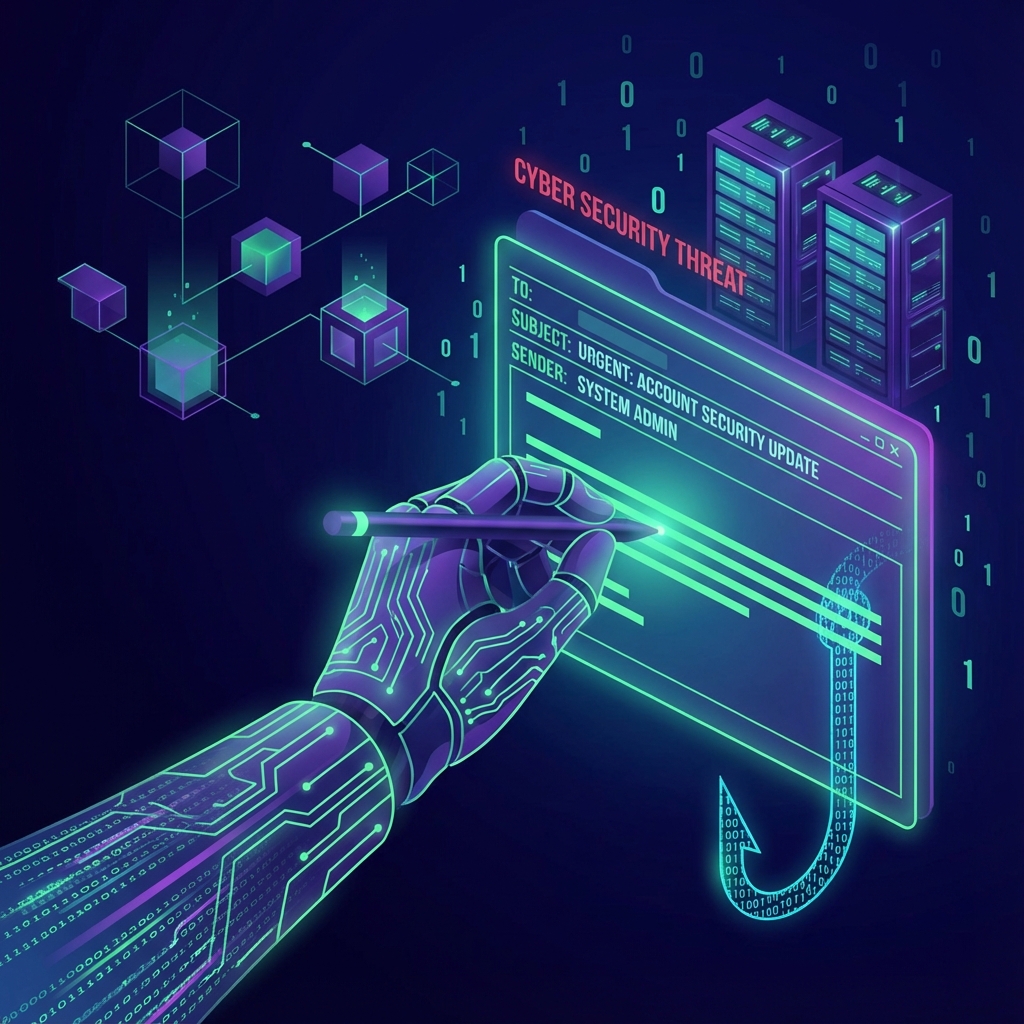
Phishing has always been a numbers game. Send enough emails, and someone will click. But in 2026, the game has fundamentally changed.
Gone are the days of poorly written emails from "Nigerian Princes" with obvious grammar errors. Today, cybercriminals are using Generative AI to craft personalized, grammatically perfect, and contextually convincing phishing campaigns at industrial scale — and they are using dark web AI tools purpose-built for cybercrime to do it.
This guide explains how AI-powered phishing works technically, the specific dark web tools enabling it, what to look for, and what technical controls actually stop it.
How AI Is Supercharging Phishing
Perfect Grammar and Tone at Scale
Traditional phishing emails were easy to spot because they were mass-produced in poorly translated English. Modern LLMs eliminate this tell entirely. AI can:
- Generate text indistinguishable from a native speaker in any language
- Mimic corporate communication style, brand voice, and professional jargon
- Adapt tone (formal, casual, urgent, friendly) based on the target's apparent seniority
- Produce thousands of unique email variants per hour to defeat hash-based spam filters
The "grammar check" red flag — the advice security awareness trainers have given for 20 years — is now completely obsolete.
Hyper-Personalization: AI Spear Phishing
Traditional spear phishing required a human analyst to research each target. AI has industrialized this process:
- An AI agent scrapes a target's LinkedIn, Twitter/X, company website, and public filings
- It builds a profile: recent projects, colleagues, reporting relationships, company announcements
- It generates a phishing email referencing real, recent context
Old way: "Dear customer, please update your account."
AI way: "Hi Sarah — great presentation at the Salesforce World Tour last week. Following up on the Q3 EMEA expansion initiative you mentioned. I've prepared an updated budget model for Tuesday's review. Can you confirm receipt? [malicious link]"
This level of personalization was previously only feasible for high-value targets (executives, finance personnel). AI has made it viable against every employee.
Deepfake Voice Cloning (Vishing)
"Vishing" (voice phishing) has become terrifyingly effective with AI voice cloning. Modern tools require as little as 30 seconds of audio — easily obtained from public LinkedIn video posts, YouTube interviews, earnings calls, or company webinars — to produce a convincing voice clone.
Attackers use this to:
- Call employees from a "spoofed" executive number and request urgent wire transfers
- Impersonate IT support requesting credentials for "emergency maintenance"
- Fabricate audio "evidence" used in social engineering chains (e.g., "Your manager asked me to contact you directly")
Real-Time AI Chat Manipulation
Malicious chatbots deployed via WhatsApp, Teams, or SMS can engage targets in real-time conversation. These bots:
- Maintain coherent conversation threads over hours or days, building trust
- Escalate to credential theft or malicious link delivery only when contextual signals indicate the target is ready
- Adapt to pushback ("Of course we have verification procedures — here is how to verify me...")
The Dark Web AI Ecosystem
This is what most security awareness training misses: the proliferation of AI tools purpose-built for cybercrime on dark web forums.
FraudGPT
First observed in July 2023 on dark web marketplaces, FraudGPT is an AI tool built on uncensored LLMs specifically for fraud:
- Generates convincing phishing email templates without safety guardrails
- Creates credential harvesting landing pages that bypass common detection
- Writes malware code and social engineering scripts
- Available via subscription: $200/month or $1,700/year
- No jailbreaking required — it was trained specifically on malicious use cases
WormGPT
A competitor to FraudGPT, WormGPT focuses specifically on Business Email Compromise (BEC) attacks:
- Trained on malware data and cybercrime forums
- Generates highly convincing BEC emails impersonating executives
- Produces urgency-optimized language specifically designed to bypass employee skepticism
- Tested and found to produce "remarkably persuasive and strategically cunning" BEC emails in independent security research
EvilGPT and GhostGPT
Subsequent dark web AI tools offering similar capabilities at lower price points have proliferated. The market for purpose-built cybercrime AI is growing faster than law enforcement can take down individual offerings.
The implication: You are no longer defending against individual hackers learning to write convincing emails. You are defending against industrialized AI phishing factories with professional development cycles, subscription pricing, and customer support.
High-Stakes Attack Types in 2026
Business Email Compromise (BEC) with AI
BEC attacks — impersonating executives to authorize fraudulent wire transfers — cost businesses over $2.9 billion per year (FBI IC3 2023). AI has dramatically lowered the barrier to execute convincing BEC attacks:
- Generate executive-sounding emails that reference real financial processes
- Spoof display names and sender domains convincingly
- Adapt to employees who question the request ("I understand your caution — here is the CFO's direct line to confirm, but she is in transit and needs this completed before 3pm...")
The Virtual Kidnapping Scam
Using voice cloning, scammers call parents and play a cloned audio clip of their child in apparent distress, claiming to have kidnapped them. The emotional manipulation is designed to force immediate action — calling 911 or a bank — before the target has time to verify. This is a social engineering attack, not a technical exploit, and it requires only seconds of publicly available audio to execute.
AI-Generated CEO Fraud on Video Calls
In one confirmed case, a finance employee was tricked into paying $25 million after a video conference call that included deepfake versions of the CFO and multiple colleagues. The employee later reported that "everyone on the call looked real." Video deepfake quality has improved to the point where single-frame detection is insufficient — real-time detection requires liveness analysis at the physiological level.
Polymorphic Phishing at Scale
AI can generate millions of unique phishing email variants — each with slightly different phrasing, subject lines, sender formatting, and link structures — faster than hash-based email security can build block lists. Traditional signature-based detection is now largely ineffective against AI-generated phishing campaigns.
How to Spot AI-Powered Phishing
Despite their sophistication, AI-generated attacks have detectable characteristics:
Verify the Logic, Not Just the Language
The key shift: stop looking for typos and start evaluating whether the request makes sense. Even a perfectly written email asking the CEO to approve an urgent $50,000 payment via gift card is obviously suspicious — regardless of grammar quality. Train employees to ask:
- Is this request consistent with how we normally handle this type of matter?
- Does this channel and urgency pattern match legitimate business communication?
- Would the real person have contacted me this way?
Out-of-Band Verification
For any request involving credentials, financial authorization, or sensitive data:
- Email request → verify by calling the person on their known direct number (not a number in the email)
- Phone call → hang up and call back on the official company directory number
- Never use contact information provided within the suspicious communication itself
AI Hallucination Patterns
AI sometimes makes up facts. If an email references a project meeting that did not happen, a colleague relationship that does not exist, or a company policy that cannot be verified, that is a significant red flag. Train employees to notice when claimed context does not match reality.
Safe Words and Challenge Protocols
For high-risk roles (finance, executive assistants, IT helpdesk), establish pre-shared challenge questions that only the real person would know. A cloned voice or deepfake cannot answer "What did we name our project in the Boston meeting in October?" correctly.
Technical Controls That Actually Work
DMARC, DKIM, and SPF (Email Authentication)
These email authentication protocols prevent the most basic form of email spoofing — sending messages that appear to come from your domain. If not already implemented, these are baseline requirements:
- SPF: Defines which mail servers are authorized to send email for your domain
- DKIM: Cryptographically signs outbound email so recipients can verify it has not been tampered with
- DMARC: Tells receiving servers what to do with unauthenticated email and provides visibility reports on spoofing attempts
Enforcing DMARC at p=reject is the most impactful single technical control for domain spoofing prevention.
AI-Powered Email Security
Legacy email gateways rely on signature matching — ineffective against AI-generated, unique-per-target phishing. Modern solutions use behavioral analysis:
- Microsoft Defender for Office 365 Plan 2 / Google Workspace Advanced Protection: Use ML to analyze communication patterns and detect anomalies — emails that look like they are from a known contact but exhibit unusual patterns (new IP, unusual attachment, atypical urgency markers)
- Abnormal Security, Proofpoint, Tessian: Purpose-built AI email security platforms that model individual communication patterns and flag deviations
Browser Isolation and Link Safety
Many phishing attacks deliver their payload via a link rather than an attachment. Browser isolation (Menlo Security, Zscaler Browser Isolation) executes web content in a remote container — even if an employee clicks a malicious link, the payload executes in an isolated environment and cannot reach the endpoint.
Alternatively, link time-of-click checking (Microsoft Safe Links, Proofpoint URL Defense) re-checks URLs at the moment of click, after any domain aging or redirect has completed.
Security Awareness Training (Updated for 2026)
The "look for typos" curriculum is outdated. Modern security awareness training must cover:
- How AI phishing works and what it looks like
- Deepfake voice and video — including live demonstrations
- The out-of-band verification process as a standard procedure, not an exceptional step
- Specific scenarios for high-risk roles (finance teams receive finance-specific BEC simulations; executives receive executive spear-phishing simulations)
Platforms like KnowBe4, Proofpoint Security Awareness, and Cofense offer AI-generated phishing simulations that match the sophistication of real attacks.
Conclusion
AI has made phishing smarter, more personalized, and more dangerous than at any point in the history of the technique. The traditional defenses — grammar checking, typo spotting, skepticism of urgent requests from unknown senders — are no longer sufficient.
The effective defense in 2026 is layered: technical controls that prevent the email from reaching employees at all (DMARC, AI email security), behavioral training that teaches employees to verify logic not just language, and organizational processes that require out-of-band confirmation for high-risk actions regardless of how convincing the request appears.
Worried about your organization's exposure to AI-powered phishing? Contact Cyberlord for a comprehensive social engineering assessment. We simulate AI-powered phishing, vishing, and deepfake attacks against your team to identify gaps before real attackers do.
Frequently Asked Questions
What is FraudGPT and how is it different from ChatGPT? FraudGPT is an uncensored AI tool sold on dark web markets specifically for cybercrime use cases. Unlike ChatGPT, it has no safety filters and was trained on malicious content to excel at writing phishing emails, generating malware, and producing social engineering scripts. It is available by subscription to anyone willing to access dark web markets.
Does DMARC stop AI phishing?
DMARC stops email spoofing — emails that falsely claim to come from your domain. It does not stop lookalike domain attacks (where attackers register companyname-security.com and send from there), compromised legitimate accounts, or AI-generated content delivered from legitimate email infrastructure. DMARC is necessary but not sufficient.
How often should we run phishing simulations? Best practice is monthly phishing simulations with immediate training for employees who click. This frequency maintains vigilance without becoming predictable. Vary the techniques — include vishing (phone-based) simulations quarterly for finance and executive assistant roles.