Deepfake Defense: Protecting Your Identity from Synthetic Fraud
David Plaha Author profile
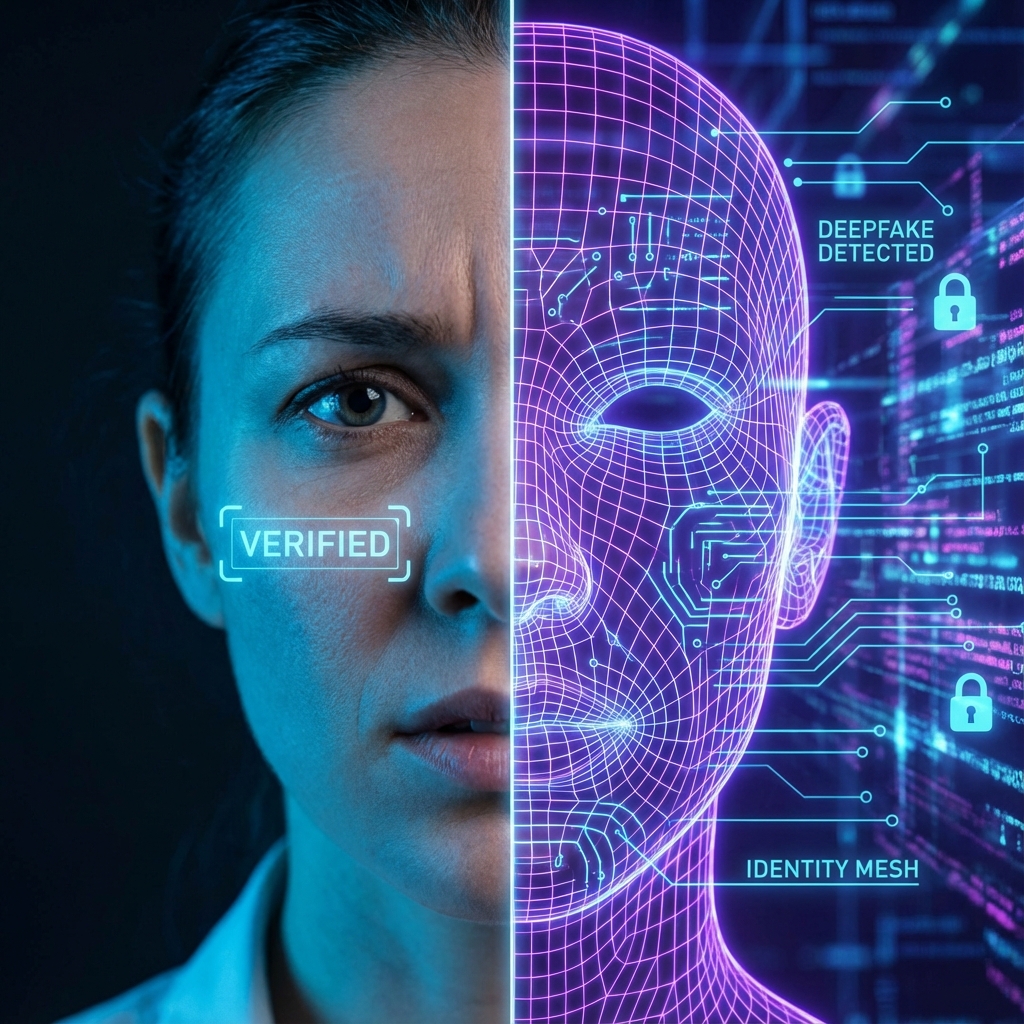
Imagine receiving a video call from your boss. You see their face, hear their voice, and watch their mannerisms. They ask you to authorize an urgent payment. You do it, only to find out later that your boss was on a flight and never made the call.
You have just been hit by a deepfake.
Once the domain of Hollywood studios and high-tech labs, deepfake technology is now available to anyone with a decent GPU and an internet connection. In 2026, synthetic identity fraud is one of the most personal and disturbing threats in the cybersecurity landscape — and it is rapidly moving from high-profile targets to ordinary individuals and SMB employees.
What Are Deepfakes?
Deepfakes are synthetic media — images, video, or audio — generated by artificial intelligence. The underlying technology relies on Generative Adversarial Networks (GANs) and, increasingly, diffusion models (the same architecture behind tools like Stable Diffusion). A GAN pits two neural networks against each other: a generator that creates synthetic media and a discriminator that tries to detect fakes. Over millions of training iterations, the generator becomes indistinguishable from reality.
Modern deepfake tools require as little as 30–60 seconds of audio to clone a voice with high fidelity. Video deepfakes require more training data but can produce convincing results from a few minutes of publicly available footage — the kind available on any corporate LinkedIn page, YouTube presentation, or news interview.
The Threat Landscape in 2026
1. Financial Fraud (The CFO Scam)
Attackers use deepfake audio and video to bypass corporate security procedures by impersonating executives. In early 2024, a finance employee at a multinational corporation was tricked into transferring $25 million after a video conference with deepfake versions of the CFO and several colleagues. These attacks are rising sharply.
2. Identity Theft and KYC Bypass
Banks and cryptocurrency exchanges rely on "Know Your Customer" (KYC) checks, often requiring a video selfie to verify identity. Criminals now use real-time deepfake tools to bypass these checks using a victim's publicly available photos, opening fraudulent accounts or laundering money through synthetic identities.
3. Reputation Damage and Sextortion
Malicious actors create non-consensual deepfake imagery or fake incriminating videos to blackmail victims. This form of harassment is rising sharply, targeting not just celebrities but private individuals, educators, politicians, and corporate executives.
4. Disinformation and Market Manipulation
Deepfakes are used to spread disinformation, manipulate stock prices (by faking executive announcements), or influence elections. In regulated industries, a fake video of an executive making a false claim about earnings can constitute securities fraud.
5. Virtual Kidnapping
Voice cloning technology enables scammers to call parents claiming to have kidnapped a family member and play a cloned audio clip to create panic. This is a purely psychological attack — the "victim" was never in danger — but it has caused real financial and emotional harm.
How Deepfake Technology Works (Technical Overview)
Understanding the generation process informs detection strategies.
Video deepfakes typically involve:
- Training a face-swap model on hundreds of frames extracted from source video
- Applying the trained model to a "driver" video (often the attacker's own face movements)
- Post-processing to align lighting, skin tone, and edge blending
Voice cloning uses:
- A small corpus of target audio (30–60 seconds is sufficient for modern tools)
- A text-to-speech model that has been fine-tuned to the target's vocal characteristics
- Real-time synthesis that can respond to conversation in under 300ms latency
Current weaknesses in deepfake generation that inform detection:
- Blurring or distortion at hairline boundaries and ear edges
- Unnatural eye blink frequency (too regular or too infrequent)
- Inconsistent lighting on the face vs. background
- Missing physiological signals: micro-expressions, natural head movement, blood flow
- Audio artifacts: unnatural breath patterns, missing room ambience, over-compressed consonants
Deepfake Defense Strategies
1. The Liveness Test (Immediate Verification)
If you suspect you are on a video call with a deepfake:
- Request unusual movement: Ask the person to turn their head sideways, wave their hand in front of their face, or hold up a physical object. Most real-time deepfake tools struggle with extreme angles and occlusion.
- Watch the edges: Focus on hairline boundaries, the area around the ears, and eye blink patterns.
- Check for audio-visual sync: Deepfake video and cloned audio are often processed separately and can exhibit subtle sync delays.
2. Out-of-Band Verification
For any financial, credential, or access request received via unusual channels:
- Hang up and call back using a known, independently verified number (not one provided by the caller).
- Use a pre-established challenge question or "safe word" that only the real person would know.
- For high-value transactions, require a second approver confirmation through a separate authenticated channel (email + phone, never just one).
3. Digital Watermarking and Content Provenance (C2PA)
The tech industry is adopting C2PA (Coalition for Content Provenance and Authenticity), a standard developed by Adobe, Microsoft, Intel, and others. C2PA embeds cryptographic provenance metadata into media files at creation, creating a verifiable chain of custody.
- Look for "Content Credentials" icons on platforms that support C2PA (Adobe Stock, selected news publishers).
- For enterprise video communications, platforms that implement C2PA attestation can cryptographically verify that a recording has not been altered.
4. AI Detection Tools
Specialized software is becoming essential for organizations:
- Intel FakeCatcher: Analyzes photoplethysmography (blood flow patterns visible in skin pixels) — something current deepfake models fail to replicate accurately.
- Deepware Scanner: Consumer-grade real-time detection for video calls.
- Microsoft's Video Authenticator: Provides a confidence score by analyzing subtle blending artifacts at the pixel level.
- Sensity AI: Enterprise-grade API for embedding deepfake detection into identity verification pipelines.
These tools are not infallible — the generation/detection arms race is ongoing — but they significantly raise the cost of a successful deepfake attack against an organization using them.
5. Reduce Your Public Biometric Footprint
Deepfakes require training data. The more high-quality video and audio of a person that is publicly accessible, the easier it is to clone them.
- Set personal social media profiles to private or limit public video content.
- For executives with elevated threat profiles, conduct a digital footprint audit to identify and reduce publicly accessible biometric data.
- Advise leadership against posting high-resolution video content that is not operationally necessary.
6. Enterprise Policy and Process Controls
Technology controls alone are insufficient. Robust process controls are the most reliable defense:
- Mandatory dual-approval for any wire transfer above a defined threshold, regardless of who requests it.
- Verbal confirmation via a second channel for any unusual request from leadership (email-only requests for financial action should automatically trigger a callback verification).
- Security awareness training that explicitly covers deepfake and voice cloning scenarios — "look for typos" is no longer sufficient training.
- Escalation procedures for any call or message that creates urgency, demands secrecy, or bypasses normal approval chains.
The Legal and Regulatory Landscape
Multiple jurisdictions are moving to criminalize malicious deepfakes:
- US: The DEEPFAKES Accountability Act (proposed) would require disclosure of synthetic media. Several states (California, Texas, New York) have specific laws against non-consensual intimate deepfakes and election interference deepfakes.
- EU: The AI Act classifies certain deepfake applications as high-risk, requiring disclosure labeling.
- UK: The Online Safety Act 2023 criminalizes non-consensual intimate deepfakes.
Organizations that produce or distribute synthetic media without disclosure may face regulatory liability in addition to reputational damage.
Conclusion
We are entering an era of "zero-trust for digital media." Seeing a face, hearing a voice, or watching a video is no longer sufficient verification of authenticity. Defense against deepfakes requires a layered approach: skepticism about unusual requests, out-of-band verification processes, AI-assisted detection technology, and biometric data minimization.
The most important shift is cultural: employees need to understand that verifying the identity of an executive requesting an urgent action is not impolite — it is a professional security responsibility.
Concerned about your organization's vulnerability to deepfake fraud? Contact Cyberlord to learn about our identity verification assessments and social engineering defense training.
Frequently Asked Questions
How accurate are deepfake detection tools? Current tools achieve 90–95% detection accuracy on lab datasets. Real-world accuracy is lower because attackers optimize against known detectors. Detection tools should be used as one layer of defense, not a sole control.
Can deepfakes be used in real-time video calls? Yes. Real-time face-swap tools exist and can run on consumer hardware. Response time is now under 300ms on modern GPUs, making real-time deepfake calls increasingly practical for attackers.
What should I do if I discover a deepfake of me online? Document everything with screenshots and metadata. Report to the platform using their synthetic media or harassment reporting flow. In the US, consult with an attorney about state-specific deepfake laws. For non-consensual intimate imagery, the Cyber Civil Rights Initiative (cybercivilrights.org) provides resources and support.