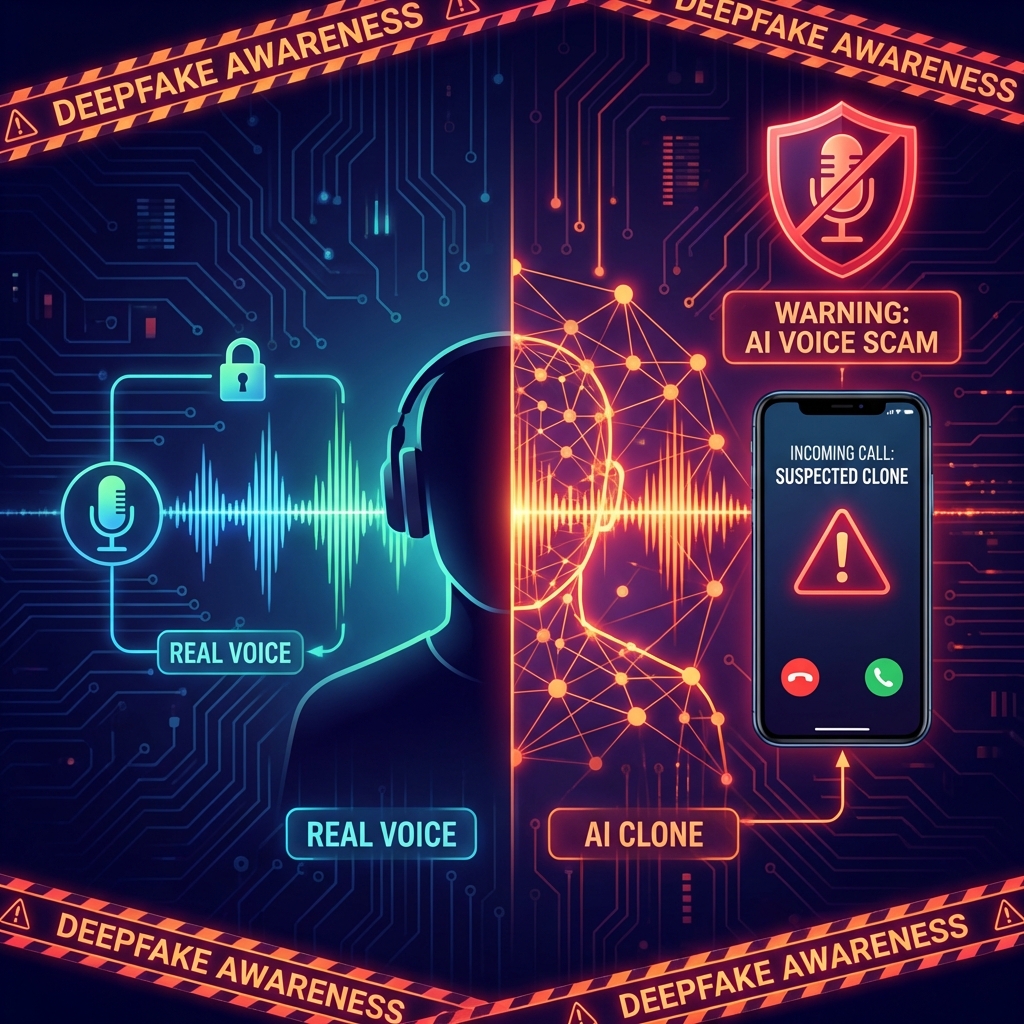
AI Voice Cloning Scams: How Hackers Clone Your Voice in 2026
CyberLord Security Team

Your phone rings. It's your daughter. She's crying, panicked, barely able to speak.
"Mom, I've been in an accident. I need you to send money right now or they're going to arrest me. Please, don't tell Dad—just send it. I'm so scared."
Every instinct screams to help her. The voice is unmistakably hers—the pitch, the way she says "Mom," even that little catch in her breath when she's upset.
You send $9,000 via wire transfer.
Two hours later, your real daughter texts: "Hey! Just landed. What's for dinner?"
You've just been hit by a Deepfake. This technology is heavily used in pig butchering scams to create fake personas and defraud families.d by AI voice cloning.
This isn't science fiction. It's happening thousands of times per month in 2026. Criminals can now clone anyone's voice with just 3 seconds of audio—a TikTok video, a voicemail greeting, a podcast appearance. And the technology is getting cheaper and more accurate by the day.
I'm a cybersecurity specialist who investigates AI-enabled fraud. This is the most emotionally devastating scam I've ever seen. Here's everything you need to know to protect yourself and your family.
How AI Voice Cloning Works
Modern voice cloning uses machine learning models trained on voice samples to generate synthetic speech that sounds identical to the original speaker.
The Technology
- Input: As little as 3-10 seconds of audio containing the target's voice
- Processing: AI analyzes vocal patterns—pitch, tone, cadence, pronunciation
- Output: Real-time or text-to-speech generation in the cloned voice
Popular tools include:
- ElevenLabs (publicly available)
- Resemble.AI
- Descript Overdub
- Open-source models like Tortoise-TTS
The terrifying part: These aren't dark web tools. Many are free and require zero technical skill.
Where Scammers Get Your Voice
| Source | Risk Level |
|---|---|
| TikTok/Instagram videos | Very High |
| YouTube content | Very High |
| Podcast interviews | High |
| Voicemail greetings | Medium |
| Phone calls (scammer records you) | Medium |
| Zoom/video meetings | Medium |
| Public speaking events | Medium |
If your voice exists anywhere on the internet, it can be cloned.
The Most Common Voice Cloning Scams
1. The "Family Emergency" Scam
Target: Parents and grandparents
How it works:
- Scammer researches victim's family on social media
- Clones the voice of a child or grandchild
- Calls claiming an emergency—accident, arrest, kidnapping
- Demands immediate wire transfer or gift cards
- Uses emotional pressure and urgency to prevent verification
Average loss: $5,000 - $25,000
Real case: In 2024, a Canadian couple lost $21,000 after receiving a call from their "son" claiming he was arrested after causing a car accident. The voice was a perfect match.
2. The "CEO Fraud" Scam (Business Email Compromise 2.0)
Target: Company employees, especially finance departments
How it works:
- Scammer clones the CEO's voice from earnings calls, interviews, or videos
- Calls an employee directly (or leaves voicemail)
- Urgently requests a wire transfer for a "confidential acquisition" or "emergency"
- Employee, believing it's the boss, processes the transfer
Average loss: $50,000 - $500,000+
Real case: In 2023, a UK energy company transferred €220,000 ($243,000) after the "CEO" called demanding an urgent payment to a supplier. The voice was AI-generated.
3. The "Kidnapping" Scam
Target: Wealthy individuals and families
How it works:
- Scammer identifies target's family member through social media
- Clones family member's voice
- Calls victim claiming their loved one has been kidnapped
- Plays audio of the "kidnapped" person screaming or crying
- Demands immediate ransom (usually crypto or wire transfer)
Average loss: $10,000 - $100,000+
This scam is particularly cruel because it creates genuine panic and fear.
4. The "Romance Upgrade" Scam
Target: Online dating users
How it works:
- Scammer creates fake dating profile using stolen photos
- After building rapport through text, they "call" using cloned voice
- The voice matches videos they've shared (actually stolen content)
- Victim believes they've verified the person is real
- Romance scam continues with enhanced trust
This makes traditional romance scams far more convincing.
Received a Suspicious Call?
We analyze voice recordings to detect AI manipulation and trace fraud operations. If you've been targeted—or already victimized—we can help investigate.
Request Voice AnalysisHow to Detect AI-Cloned Voices
The technology is good—but not perfect. Here are the telltale signs:
Audio Artifacts to Listen For
Unnatural breathing patterns
- Real speech has natural breaths between sentences
- AI often omits or standardizes breathing sounds
Robotic undertones
- Listen for subtle metallic or synthetic quality
- Most noticeable in emotional expressions
Inconsistent background noise
- Real calls have consistent ambient sound
- AI voices may have perfectly clean backgrounds or inconsistent noise
Weird pronunciation
- AI struggles with unusual names, places, or slang
- May mispronounce family nicknames or inside jokes
Latency issues
- Real-time voice cloning has slight delays
- Responses may lag unnaturally
Behavioral Red Flags
Extreme urgency
- "You have to do this RIGHT NOW"
- Discourages any verification attempts
Requests for unusual payment methods
- Gift cards, wire transfers, crypto
- Never normal bank transfers
Instructions to keep secret
- "Don't tell anyone about this"
- Isolation prevents verification
Won't answer verification questions
- Dodges personal questions
- Gets defensive or changes subject
Call quality is "too good"
- AI-generated audio often sounds studio-quality
- Real phone calls have compression artifacts
The Family Safe Word Protocol
The single most effective defense against voice cloning scams is establishing a family safe word or verification question that only your family knows.
How to Set It Up
Choose a word or phrase
- Something memorable but not guessable
- Not something you'd post online
- Examples: "Purple banana," "Aunt Martha's cat," a random phrase
Share it with immediate family
- In person, not over phone or text
- Make sure everyone memorizes it
Establish the protocol
- Any urgent request for money requires the safe word
- No safe word = hang up and verify independently
Practice using it
- Occasionally test it in normal calls
- Keeps it fresh in everyone's memory
Sample Conversation
Scammer (using cloned voice): "Dad, I'm in jail. I need $5,000 for bail."
You: "Okay, but first—what's our family word?"
Scammer: "What? Dad, I don't have time for this! Just send the money!"
You: "I can't help without the word. I'll call you back on your regular number."
[Hang up. Call your child directly. Scam avoided.]
Technical Protection Measures
For Individuals
Limit public voice exposure
- Make TikTok/Instagram private or reduce voice content
- Use video messages sparingly on social media
Change your voicemail greeting
- Use a generic or text-based greeting
- Don't say your name in your voicemail
Enable call screening
- Google Pixel's Call Screen feature
- Third-party apps that analyze incoming calls
Register on Do Not Call list
- Reduces overall scam call exposure
- donotcall.gov (US)
For Businesses
Multi-person authorization for transfers
- No single person can authorize large payments
- Require callback verification on separate line
Establish voice verification protocols
- Safe words for executives
- Video call requirement for urgent requests
Train employees on AI threats
- Regular security awareness training
- Specific modules on voice cloning
Limit executive voice exposure
- Reduce public speaking recordings online
- Watermark or protect earnings call audio
Voice Deepfake Detection Technology
Security companies are racing to build AI that detects AI:
Available Detection Tools
| Tool | Use Case | Accuracy |
|---|---|---|
| Pindrop | Call center authentication | 90%+ |
| Resemble Detect | Audio file analysis | 85%+ |
| Microsoft VALL-E detector | Research/enterprise | 80%+ |
| McAfee Deepfake Detector | Consumer protection | 75%+ |
How Detection Works
- Spectral analysis: Examines audio frequencies for synthetic patterns
- Artifact detection: Identifies compression and generation artifacts
- Behavioral analysis: Compares speech patterns against known samples
- Neural network classification: AI trained to identify AI
The arms race: Detection improves, but so does generation. This is an ongoing battle.
What to Do If You've Been Scammed
Immediate Actions
Contact your bank immediately
- Request wire transfer recall
- Freeze accounts if necessary
- Document all transactions
Report to authorities
- FBI IC3: ic3.gov
- FTC: reportfraud.ftc.gov
- Local police report
Document everything
- Save any voicemails or recordings
- Screenshot all communications
- Write down everything you remember
Contact the "victim"
- Verify your real family member is safe
- Explain what happened
Can You Recover the Money?
Recovery depends on payment method:
| Payment Method | Recovery Chance |
|---|---|
| Wire transfer (same day) | Medium - call bank immediately |
| Wire transfer (1+ days) | Very Low |
| Gift cards | Nearly impossible |
| Cryptocurrency | Low - requires investigation |
| Credit card | High - dispute the charge |
Professional investigation can trace cryptocurrency payments and identify scammers for law enforcement, but direct recovery is challenging.
The Legal Landscape
Voice cloning for fraud is illegal, but laws are still catching up:
United States
- Wire fraud (18 USC 1343): Up to 20 years prison
- Identity theft (18 USC 1028): Up to 15 years prison
- Some states passing specific deepfake laws
European Union
- GDPR implications for voice data misuse
- AI Act includes provisions on synthetic media
Challenges
- Scammers often operate internationally
- Attribution is difficult
- Technology outpaces legislation
The Future: What's Coming in 2026 and Beyond
Voice cloning will become:
- Real-time and indistinguishable from real speech
- Multilingual (clone in English, output in Spanish)
- Emotional (accurate crying, laughing, anger)
- Cheaper (free tools with premium quality)
New attack vectors:
- Smart speaker manipulation (cloning household member voices to authorize purchases)
- Authentication bypass (voice-based security systems)
- Social engineering at scale (automated scam calls with personalized cloned voices)
Defenses must evolve:
- Hardware-based voice authentication
- Blockchain voice verification
- Universal safe word protocols
- AI legislation and enforcement
Conclusion: Trust But Verify
We've entered an era where you cannot trust your ears. The voice of your child, your spouse, your boss—any of them can be synthetically generated by someone with internet access and malicious intent.
This isn't cause for paranoia, but it demands new habits:
- Establish family safe words today
- Never act on urgent money requests without verification
- Call back on known numbers, not caller ID
- Educate elderly relatives who are prime targets
- Reduce your voice footprint online
The technology exists. The scammers are using it. Your awareness is the primary defense.
If you've received a suspicious call, been victimized, or need to train your organization on AI voice threats—we're here to help.
Your voice shouldn't be used against you.
Frequently Asked Questions (FAQs)
1. How much audio do scammers need to clone my voice?
Modern AI voice cloning can work with as little as 3 seconds of audio. Higher quality clones typically use 10-30 seconds. If you have any video content online—TikTok, Instagram, YouTube—scammers have enough material to clone your voice.
2. Can I tell if a call is AI-generated just by listening?
Sometimes. Listen for unnatural breathing, robotic undertones, or weird pauses. However, the technology is improving rapidly. By late 2026, most people won't be able to distinguish high-quality clones from real voices by ear alone. That's why verification protocols are essential.
3. My elderly parent was scammed. What do I do?
First, comfort them—these scams are psychologically sophisticated and anyone can fall victim. Then: contact their bank immediately to attempt recovery, file an FBI IC3 report, report to local police, and help them set up a family safe word for the future. Consider professional investigation if large amounts were lost.
4. Is voice cloning illegal?
Creating voice clones isn't inherently illegal—many legitimate uses exist. However, using cloned voices for fraud, impersonation, or to deceive is illegal under wire fraud, identity theft, and various state laws. The legal framework is evolving as the technology spreads.
5. How can I protect my voice from being cloned?
Completely preventing cloning is nearly impossible if your voice is online. Focus on: (1) reducing public voice content, (2) making social media private, (3) using generic voicemail greetings, and most importantly (4) establishing verification protocols so cloning can't be weaponized against your family.
6. Can businesses verify callers are real?
Yes. Enterprise solutions like Pindrop provide voice biometric authentication and deepfake detection for call centers. For internal communications, companies should establish callback protocols, multi-person authorization for payments, and safe word systems for executives.
ai voice cloning scams 2026 guide overview
Key decisions, risks, and implementation actions for ai voice cloning scams 2026 guide.