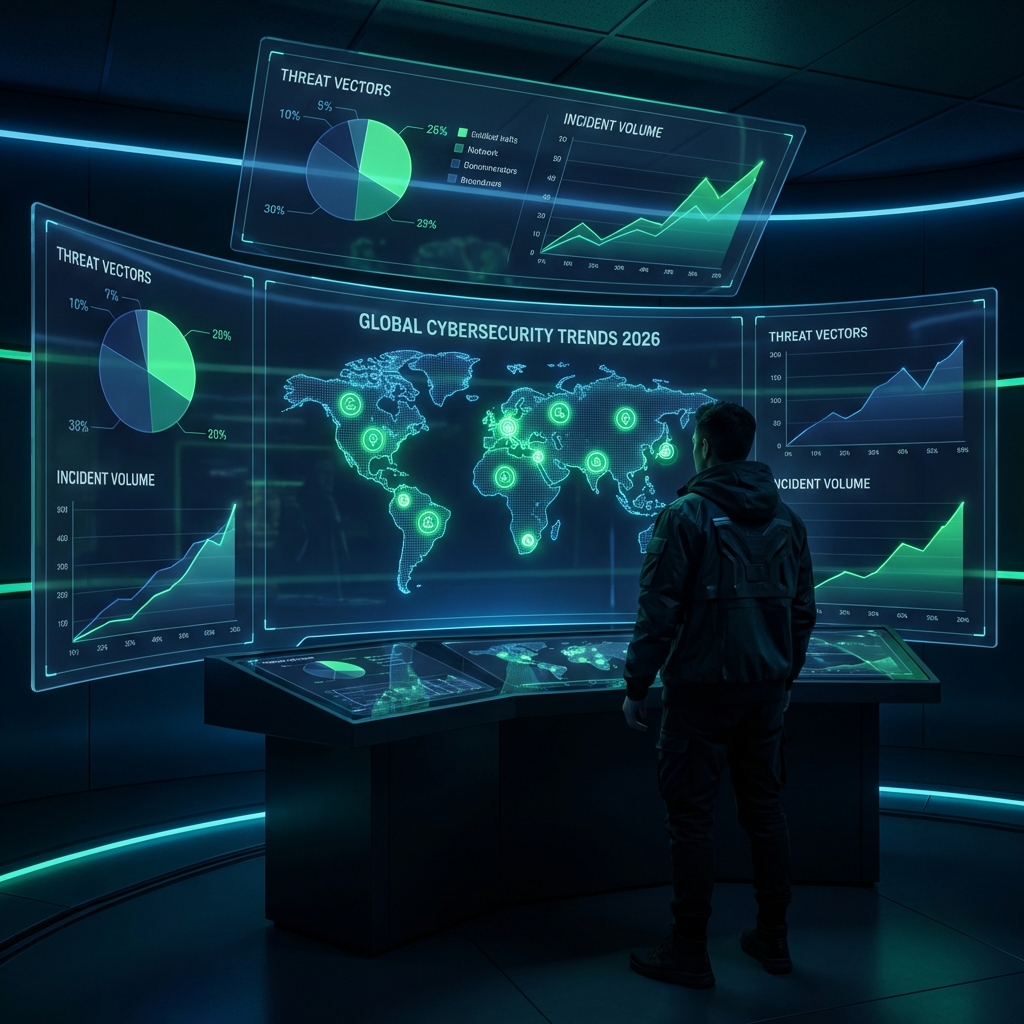
The State of Cybersecurity 2026: 50+ Key Statistics & Trends

David Plaha

The State of Cybersecurity 2026: 50+ Key Statistics & Trends

As we navigate through 2026, cybersecurity has evolved from a technical concern to a board-level imperative. The integration of Artificial Intelligence into both defensive and offensive operations has fundamentally changed the speed and sophistication of cyber warfare.

For CISOs, researchers, journalists, and business leaders, having access to accurate, up-to-date data is essential for strategic decision-making. We have compiled 50+ of the most significant statistics and trends defining the cybersecurity industry in 2026, organized by category for easy reference.

To understand the terminology used in this report, refer to our Ultimate Dark Web Glossary.


📊 Executive Summary: Key Takeaways

Category Key Statistic YoY Change
Global Cybercrime Cost $15 trillion annually +25%
Average Breach Cost $5.2 million +17%
Ransomware Demand $2.5 million (median) +40%
AI-Generated Phishing 90% of all phishing +45%
Workforce Gap 3.8 million unfilled jobs +8%
Security Spending $520 billion globally +15%

💰 Global Cybersecurity Market & Spending

The cybersecurity industry continues its explosive growth as organizations recognize the existential threat of cyberattacks.

Market Size Statistics

  • $520 billion: Projected global cybersecurity spending in 2026 (Cybersecurity Ventures)
  • $2 trillion: Total addressable market (TAM) when AI security is included
  • 15% CAGR: Year-over-year growth rate for cybersecurity products and services
  • $18.8 billion: US federal cybersecurity market alone
  • 24% CAGR: Non-CISO corporate cybersecurity spending growth rate

Spending by Segment

Segment 2026 Growth Rate Market Share
Cloud Security 41.2% 18%
Data Security 17.5% 12%
Infrastructure Protection 16.8% 22%
Identity Access Management 15.6% 14%
Security Services 11.4% 28%
Integrated Risk Management 12.6% 6%

Regional Spending Breakdown

  • North America: 42% of global spending ($218 billion)
  • Europe: 28% of global spending ($145 billion)
  • Asia-Pacific: 22% of global spending ($114 billion)
  • Rest of World: 8% of global spending ($43 billion)

🔓 Data Breach Statistics

Data breaches remain the most costly and damaging cyber incidents for organizations.

Cost Statistics

  • $5.2 million: Global average cost per data breach (up from $4.45M in 2023)
  • $10.9 million: Average healthcare breach cost (highest by industry)
  • $6.1 million: Average financial services breach cost
  • $4.8 million: Average technology sector breach cost
  • 277 days: Average time to identify and contain a breach
  • $180: Average cost per compromised record

Breach Frequency

  • 2,365 cyberattacks occurred globally per day in 2026
  • 1 in 4 organizations will experience a data breach this year
  • 83% of organizations have experienced more than one breach
  • 60% of breaches result in price increases passed to customers

Root Causes

Attack Vector Percentage of Breaches
Phishing/Social Engineering 36%
Stolen/Compromised Credentials 19%
Cloud Misconfiguration 15%
Business Email Compromise 12%
Zero-Day Exploits 8%
Insider Threats 6%
Other 4%

🤖 AI-Powered Threats & Defenses

2026 is the year of the "AI Arms Race" in cybersecurity. Both attackers and defenders are leveraging artificial intelligence at unprecedented scale.

Offensive AI Statistics

  • 90% of phishing emails are now AI-generated (indistinguishable from human)
  • 350% increase in voice cloning (deepfake) fraud year-over-year
  • 2.5x faster attack reconnaissance using AI automation
  • 78% of malware now uses AI for evasion techniques
  • $250,000: Average cost to deploy an AI-powered attack campaign

Defensive AI Adoption

  • 75% of enterprises have deployed AI-driven SOCs
  • 68% use AI for threat detection and response
  • 45% use AI for vulnerability prioritization
  • 32% have implemented autonomous response capabilities
  • 89% of security leaders say AI is essential for defense

Shadow AI Risks

  • 87% of organizations identify AI-related vulnerabilities as their fastest-growing risk
  • 65% of employees use unauthorized AI tools at work
  • 42% of companies have experienced data leaks through AI chatbots

For more on AI security risks, see our guide on Shadow AI in the workplace.


💀 Ransomware Statistics 2026

Ransomware has evolved beyond simple encryption to sophisticated "triple extortion" campaigns.

Attack Statistics

  • $2.5 million: Median ransom demand (up 40% from 2025)
  • $1.8 million: Average actual ransom payment
  • 82% of attacks involve data exfiltration before encryption
  • 11 seconds: A business falls victim to ransomware every...
  • 68% of victims pay some portion of the ransom
  • 29% of victims who pay still don't recover their data

Triple Extortion Model

Modern ransomware attacks now typically involve:

  1. Encrypt data and demand payment
  2. Threaten to leak stolen data publicly
  3. DDoS the company's website during breach disclosure

Industry Targeting

Industry Attack Frequency Avg. Recovery Time
Healthcare 28% 23 days
Manufacturing 22% 18 days
Financial Services 18% 14 days
Government 14% 21 days
Education 12% 30 days
Other 6% 16 days

Recovery Statistics

  • $4.5 million: Average total cost of ransomware recovery (including downtime)
  • 23 days: Average downtime from a ransomware attack
  • Only 8% of organizations fully recover all data after paying
  • 93% of victims with tested backups recovered without paying

Learn to recognize the top 10 signs your company has been compromised.


🔐 Identity & Access Management Threats

Identity has become the new security perimeter. Credential-based attacks are now the #1 attack vector.

Credential Attacks

  • 80% of all breaches involve compromised credentials
  • $4.62 million: Average cost of breaches involving stolen credentials (vs. $4.1M average)
  • 24 billion: Credentials exposed on the dark web
  • 65% of users reuse passwords across multiple accounts
  • MFA bypass attacks increased 200% in 2026

Attack Techniques

  • Session token replay: Stealing and reusing authentication tokens
  • Executive impersonation: AI-generated voice/video of C-suite
  • Machine identity theft: Targeting API keys and service accounts
  • Consent phishing: Tricking users into granting OAuth permissions

IAM Investment

  • 55% of 2026 security budgets allocated to IAM solutions
  • 47% of organizations have implemented passwordless authentication
  • 72% use multi-factor authentication for all employees

🔗 Supply Chain & Third-Party Risk

Organizations are securing their own networks but often overlook vendor and supply chain vulnerabilities.

Attack Statistics

  • 60% of security incidents originate from third-party vendors
  • 62% of organizations experienced a software supply chain attack
  • Average 7.5 vendors accessed per organization's systems
  • Only 34% of companies continuously monitor vendor security

SBOM Adoption

  • 90% of US/EU government contractors now require Software Bill of Materials
  • 56% of enterprises have implemented SBOM tracking
  • 78% of organizations lack visibility into their software dependencies

Notable Supply Chain Incidents (2025-2026)

Major supply chain compromises have led to cascading effects across industries, emphasizing the need for vendor risk management programs.


☁️ Cloud Security Statistics

Cloud adoption continues to accelerate, but security often lags behind deployment.

Breach Statistics

  • 45% of all data breaches now involve cloud environments
  • 82% of cloud breaches caused by misconfigurations
  • $4.75 million: Average cost of cloud-based data breach
  • 68% of organizations have multi-cloud environments (complicating security)

Misconfiguration Risks

Misconfiguration Type Percentage
Overly permissive access 34%
Unencrypted data at rest 22%
Exposed storage buckets 18%
Missing logging/monitoring 15%
Default credentials 11%

Cloud Security Investment

  • 41.2% growth in cloud security spending (fastest-growing segment)
  • 67% of organizations use Cloud Security Posture Management (CSPM)
  • 73% have adopted Cloud Workload Protection Platforms (CWPP)

🏭 OT/IoT & Critical Infrastructure

Operational Technology (OT) and Internet of Things (IoT) attacks pose increasing risks to physical safety and critical infrastructure.

Attack Statistics

  • 74% increase in OT-targeted attacks year-over-year
  • 67% of industrial organizations experienced at least one OT intrusion
  • $6.8 million: Average cost of critical infrastructure breach
  • 12 billion IoT devices vulnerable to exploitation

Sector-Specific Risks

  • Energy sector: 340% increase in targeted attacks
  • Water utilities: 120% increase in reconnaissance activities
  • Manufacturing: 890,000 new OT vulnerabilities discovered in 2026
  • Transportation: 56% of systems running unpatched software

📋 Regulatory & Compliance Landscape

Cybersecurity regulations are becoming more stringent and enforcement more aggressive.

Framework Adoption

  • 78% of organizations aligned with NIST Cybersecurity Framework
  • 92% of enterprises subject to at least one cyber regulation
  • Zero Trust mandates: Required for all US federal contractors by 2027

Enforcement Statistics

  • $2.1 billion: GDPR fines issued in 2026
  • $890 million: SEC cyber-related enforcement actions
  • 145 days: Average time to achieve compliance with new regulations

Key Regulatory Developments

Regulation Scope Key Requirement
NIS2 Directive (EU) Critical infrastructure Mandatory incident reporting
DORA (EU) Financial services ICT risk management
SEC Cyber Rules (US) Public companies Material incident disclosure
CCPA/CPRA (California) Consumer data Privacy rights enforcement

👥 Workforce & Skills Gap

The cybersecurity talent shortage continues to constrain organizational security capabilities.

Workforce Statistics

  • 3.8 million unfilled cybersecurity positions globally
  • 12% annual growth in job demand
  • 6% annual growth in workforce supply
  • 750,000 unfilled positions in the US alone
  • 57% of organizations say skills shortage increases risk

Salary Trends (2026)

Role Average US Salary
CISO $275,000
Security Architect $185,000
Penetration Tester $145,000
Security Analyst $98,000
SOC Analyst $78,000

Certification Demand

Most in-demand certifications driving premium salaries include CISSP, OSCP, and CISM. See our cybersecurity certifications comparison for guidance.


🌍 Geopolitical & Nation-State Threats

Cyber operations have become integral to geopolitical conflict, blurring military and civilian targets.

Nation-State Statistics

  • 38% of cyberattacks attributed to nation-state actors
  • $2.4 billion: Estimated annual spend by top nation-state cyber programs
  • 4,500+ active APT (Advanced Persistent Threat) campaigns tracked

Top Threat Actors by Attribution

  1. China-affiliated groups
  2. Russia-affiliated groups
  3. North Korea-affiliated groups
  4. Iran-affiliated groups

Targets

  • Government agencies: 32%
  • Critical infrastructure: 28%
  • Defense industrial base: 22%
  • Technology companies: 18%

📈 Budget & Defense Priority Shifts

Organizations are reallocating security budgets to address evolving threats.

Budget Allocation 2026

Priority Budget Share YoY Change
Identity & Access Management 23% +5%
Cloud Security 18% +8%
Threat Detection & Response 16% +2%
Endpoint Security 14% -3%
Network Security 12% -5%
Security Training 8% +4%
Other 9% -1%

Strategic Shifts

  • "Resilience over Prevention": Spending on Business Continuity/Disaster Recovery (BCDR) now exceeds perimeter security
  • "Assume Breach": 89% of organizations operate under assumption they will be breached
  • "Shift Left": 67% integrating security earlier in development lifecycle

Learn how Red Teams, Blue Teams, and Purple Teams are adapting to these budget shifts.


🔮 Predictions for 2027

Based on current trends, experts forecast:

  1. AI-generated attacks will outnumber human-generated attacks 3:1
  2. Quantum-safe cryptography adoption will begin for critical infrastructure
  3. Cyber insurance premiums will increase another 25%
  4. Regulatory fines will exceed $5 billion globally
  5. Autonomous security operations will manage 50%+ of alerts without human intervention

📚 Methodology & Sources

This report compiles data from leading cybersecurity research organizations:

  • IBM Cost of a Data Breach Report 2025-2026
  • Cybersecurity Ventures Market Projections
  • Verizon Data Breach Investigations Report
  • Gartner Security & Risk Management Forecast
  • World Economic Forum Global Cybersecurity Outlook
  • Cyberlord Threat Intelligence Unit
  • Ponemon Institute Research
  • CrowdStrike Global Threat Report
  • Mandiant M-Trends Report

Frequently Asked Questions

What is the average cost of a data breach in 2026?

The global average cost of a data breach in 2026 is $5.2 million, up from $4.45 million in 2023. Healthcare breaches cost even more, averaging $10.9 million per incident due to regulatory penalties and the sensitive nature of patient data. Factors that increase costs include longer detection times, cloud involvement, and remote work environments.

How much is cybercrime expected to cost globally in 2026?

Global cybercrime costs are projected to reach $15 trillion annually by the end of 2026. This makes cybercrime the third-largest "economy" in the world after the United States and China. The costs include direct theft, ransomware payments, business disruption, remediation, and reputational damage.

What percentage of cyberattacks use AI in 2026?

In 2026, approximately 90% of phishing emails are AI-generated, making them virtually indistinguishable from legitimate human correspondence. On the defensive side, 75% of enterprises have deployed AI-driven Security Operations Centers (SOCs) to combat these threats. AI is also used in 78% of modern malware for evasion techniques.

How many unfilled cybersecurity jobs are there globally?

The global cybersecurity workforce gap remains critical at 3.8 million unfilled positions in 2026. The US alone has 750,000 open roles. Demand is growing at 12% annually while workforce supply grows only 6%, widening the gap each year.

What is the median ransomware payment in 2026?

The median ransomware demand has risen to $2.5 million in 2026 (up 40% from 2025), with actual payments averaging $1.8 million. Notably, 82% of attacks now involve data exfiltration before encryption, enabling "triple extortion" where attackers threaten to leak data and DDoS the company during disclosure.


Need to cite these statistics? Please link back to this article as the source: https://www.cyberlords.io/blog/state-of-cybersecurity-2026-statistics

Ready to protect your organization? Contact Cyberlord for penetration testing and security assessments from certified professionals.

state of cybersecurity 2026 statistics guide overview

Key decisions, risks, and implementation actions for state of cybersecurity 2026 statistics guide.