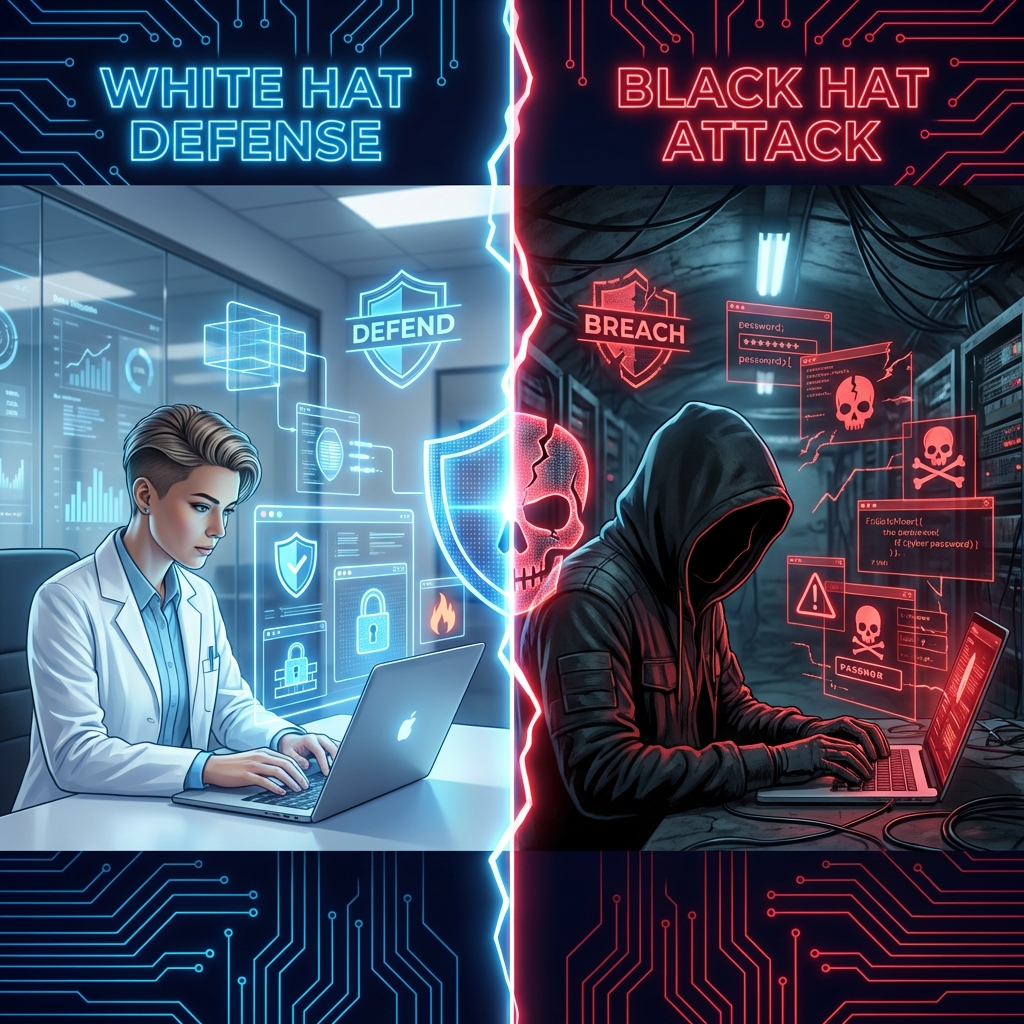
White hat и black hat: кто нужен, когда вы нанимаете хакера
CyberLord Security Team

When you decide to "hire a hacker," you're entering a world with stark moral and legal divisions. The difference between white hat and black hat hackers isn't just terminology—it's the line between protecting your business and committing federal crimes. One will strengthen your security posture and keep you compliant with regulations; the other will land you in prison.
This guide eliminates the confusion. You'll learn exactly what distinguishes white hat from black hat hackers, understand the gray hat middle ground, discover which type of professional you actually need, and learn how to identify legitimate ethical hackers who can protect your organization in 2025. Understanding this distinction is step one to hire a hacker safely.

White Hat vs. Black Hat Hacker: The Fundamental Differences
White Hat Hackers (Ethical Hackers)
White hat hackers are cybersecurity professionals who use their technical skills to identify and fix security vulnerabilities with explicit permission from system owners. They operate within legal and ethical boundaries to protect organizations from cyber threats.
Key Characteristics:
- Authorization: Always work with written permission
- Motivation: Improve security and prevent harm
- Legality: Operate within all applicable laws and regulations
- Transparency: Provide detailed reports and remediation guidance
- Certifications: Hold credentials like CEH, OSCP, CISSP, or CREST
- Accountability: Carry professional liability insurance and operate under contracts
Common Services:
- Penetration testing of web applications, networks, and cloud infrastructure
- Vulnerability assessments and security audits
- Social engineering testing and employee awareness training
- Compliance testing for PCI DSS, HIPAA, GDPR, and other regulations
- Red team operations simulating advanced persistent threats
- Bug bounty program participation
Black Hat Hackers (Malicious Hackers)
Black hat hackers exploit computer systems and networks without authorization for personal gain, causing harm, or other malicious purposes. Their activities are illegal and can result in severe criminal penalties.
Key Characteristics:
- No Authorization: Access systems without permission
- Motivation: Financial gain, revenge, recognition, or causing damage
- Legality: Violate the Computer Fraud and Abuse Act and other laws
- Secrecy: Operate anonymously to avoid detection and prosecution
- No Credentials: Lack legitimate certifications or verifiable identity
- No Accountability: Offer no recourse if things go wrong
Common Activities:
- Data theft and selling stolen information on dark web markets
- Deploying ransomware and extorting victims
- Stealing financial information and committing fraud
- Installing malware, spyware, and backdoors
- Conducting distributed denial-of-service (DDoS) attacks
- Corporate espionage and intellectual property theft

The Critical Distinction
The white hat vs. black hat hacker debate boils down to one fundamental question: Do they have permission?
White hat hackers always operate with explicit, documented authorization. Black hat hackers never do. This single distinction determines whether an activity is legal cybersecurity work or federal computer crime.
Understanding whether hiring a hacker is legal depends entirely on this distinction.
Gray Hat Hackers: The Dangerous Middle Ground
Gray hat hackers occupy a legally questionable space between white and black hat hackers. They may discover vulnerabilities without permission but don't exploit them maliciously.
Typical Gray Hat Scenario:
- Hacker finds vulnerability in a company's system without authorization
- Accesses the system to verify the vulnerability (illegal)
- Contacts the company to disclose the issue
- Sometimes requests payment for the information
Legal Status: Even though gray hat hackers may have good intentions, their initial unauthorized access violates laws like the CFAA. Companies should never hire gray hat hackers, as doing so could make you complicit in illegal activities.
The Problem: What starts as unauthorized "research" can quickly become a legal nightmare. Several security researchers have faced prosecution for gray hat activities, even when trying to help.
White Hat vs. Black Hat Hacker: Side-by-Side Comparison
| Aspect | White Hat Hacker | Black Hat Hacker |
|---|---|---|
| Authorization | Written permission required | No permission or authorization |
| Legal Status | Completely legal when properly engaged | Federal crime under CFAA |
| Motivation | Improve security, prevent harm | Personal gain, cause damage |
| Transparency | Full disclosure to client | Secretive, anonymous operations |
| Methodology | Documented, systematic approach | Unrestricted, often destructive |
| Credentials | CEH, OSCP, CISSP, CREST certifications | No verifiable credentials |
| Reporting | Comprehensive vulnerability reports | No reporting (or ransom demands) |
| Remediation | Provides fix recommendations | Exploits vulnerabilities |
| Insurance | Professional liability coverage | No accountability or recourse |
| Cost | $5,000-$150,000+ for services | Potential millions in damages |
| Outcome | Stronger security posture | Data breaches, system damage, legal liability |
What You Actually Need: Understanding Your Requirements
When you think you need to "hire a hacker," what you actually need is a white hat ethical hacker. Here's how to match your needs to the right services:
Scenario 1: Testing Your Security
Your Need: Identify vulnerabilities before attackers do
What You Need: White hat penetration tester
Services:
- Web application penetration testing ($5,000-$25,000)
- Network security assessment ($8,000-$50,000)
- Cloud infrastructure testing ($10,000-$40,000)
Why Not Black Hat: Hiring someone to "hack" your own systems without proper authorization and contracts exposes you to legal liability and provides no recourse if something goes wrong. Learn how to hire a hacker safely.
Scenario 2: Compliance Requirements
Your Need: Meet PCI DSS, HIPAA, GDPR, or other regulatory standards
What You Need: Certified white hat security auditor
Services:
- Compliance-focused penetration testing
- Security control validation
- Regulatory audit preparation
- Documentation for compliance reporting
Why Not Black Hat: Compliance requires documented, authorized testing by qualified professionals. Black hat hackers provide none of this.

Scenario 3: Employee Security Awareness
Your Need: Test how employees respond to phishing and social engineering
What You Need: White hat social engineering specialist
Services:
- Simulated phishing campaigns ($1,000-$10,000)
- Social engineering testing
- Security awareness training
- Incident response drills
Why Not Black Hat: Legitimate testing includes employee education and improvement, not exploitation.
Scenario 4: Continuous Security Monitoring
Your Need: Ongoing vulnerability detection and threat monitoring
What You Need: Managed security services provider or continuous penetration testing platform
Services:
- 24/7 security monitoring ($2,000-$5,000/month for 50-100 users)
- Continuous vulnerability scanning
- Threat intelligence integration
- Incident response capabilities
Why Not Black Hat: You need a trusted partner, not a criminal who could turn on you at any moment.
Scenario 5: Bug Bounty Program
Your Need: Crowdsourced security testing from multiple researchers
What You Need: Bug bounty platform with vetted white hat researchers
Services:
- Platforms like HackerOne, Bugcrowd, or Intigriti
- Defined scope and rules of engagement
- Managed disclosure process
- Payment for verified vulnerabilities
Why Not Black Hat: Bug bounty platforms provide legal safe harbor and structured processes that protect both you and researchers.
How to Identify Legitimate White Hat Hackers
Understanding white hat vs. black hat hacker differences is crucial, but you also need to identify legitimate professionals:
1. Verify Professional Certifications
Legitimate white hat hackers hold recognized certifications:
Entry to Mid-Level:
- CEH (Certified Ethical Hacker): EC-Council certification covering ethical hacking fundamentals
- CompTIA PenTest+: Vendor-neutral penetration testing certification
- GPEN (GIAC Penetration Tester): SANS Institute practical certification
Advanced Level:
- OSCP (Offensive Security Certified Professional): Hands-on, practical penetration testing
- OSCE (Offensive Security Certified Expert): Advanced exploitation techniques
- CREST Certified: Rigorous UK-based certification for penetration testers
Management Level:
- CISSP (Certified Information Systems Security Professional): Comprehensive security knowledge
- CISM (Certified Information Security Manager): Security management focus
Verification: Always verify certification numbers directly with issuing organizations. Don't accept screenshots or certificates at face value.
2. Check Professional Background
Legitimate white hat hackers have verifiable professional histories:
- LinkedIn profiles with detailed work history and recommendations
- GitHub repositories showing security tools and contributions
- Published research in security blogs, conferences, or academic journals
- CVE disclosures demonstrating responsible vulnerability discovery
- Speaking engagements at security conferences like DEF CON, Black Hat, or BSides
3. Assess Communication and Professionalism
White hat hackers operate as business professionals:
- Clear communication: Can explain technical concepts to non-technical stakeholders
- Professional website: Legitimate business presence with contact information
- Video calls: Willing to meet face-to-face via video conferencing
- References: Can provide sanitized case studies or client references
- Business registration: Verifiable company registration and tax information

4. Review Contract and Legal Framework
Legitimate engagements always include:
- Detailed scope of work: Specific systems, methodologies, and limitations
- Written authorization: Explicit permission for all testing activities
- Non-disclosure agreements: Protecting your sensitive information
- Liability clauses: Defining responsibilities and insurance coverage
- Payment terms: Milestone-based or escrow-protected payments
- Deliverables: Clear expectations for reports and remediation guidance
5. Evaluate Pricing Realistically
Understanding market rates helps identify scams:
Red Flags:
- Prices significantly below market rates ($500 for comprehensive penetration testing)
- Guaranteed results ("We'll hack any account")
- Upfront payment demands via untraceable methods
- Vague pricing with no detailed breakdown
Realistic Pricing (2025):
- Junior ethical hackers: $50-$150/hour
- Experienced professionals: $200-$500/hour
- Specialized firms: $250-$1,000/hour
- Project-based: $5,000-$150,000+ depending on scope
Red Flags: Spotting Black Hat Scammers
When evaluating the white hat vs. black hat hacker distinction, watch for these warning signs:
Immediate Disqualifiers
- Offers illegal services: "Hack into any email account," "Steal competitor data," "Access phone records"
- Demands untraceable payment: Bitcoin, gift cards, or wire transfers before work begins
- No verifiable identity: Refuses video calls, provides only encrypted messaging contact
- Guaranteed outcomes: Promises specific results without assessing your systems
- Pressure tactics: Creates urgency to prevent due diligence
- No contract or NDA: Unwilling to formalize the engagement legally
- Anonymous communication: Only communicates through Telegram, WhatsApp, or dark web forums
Subtle Warning Signs
- Reluctance to discuss methodology in detail
- No professional website or business presence
- Unable to provide verifiable references
- Vague or inconsistent answers about certifications
- Unwillingness to work with your legal team
- No mention of insurance or liability protection
- Poor communication skills or unprofessional behavior

The Legal Consequences of Hiring Black Hat Hackers
Understanding white hat vs. black hat hacker differences includes recognizing the legal risks. Learn more about whether hiring a hacker is legal.
Criminal Liability
Hiring a black hat hacker makes you complicit in federal crimes:
- CFAA violations: Conspiracy to commit computer fraud (up to 20 years imprisonment)
- Wire fraud: If payment crosses state lines (up to 20 years imprisonment)
- Identity theft: If personal information is accessed (up to 15 years imprisonment)
- RICO charges: If part of ongoing criminal enterprise (up to 20 years imprisonment)
Civil Consequences
- Lawsuits from victims: For damages resulting from unauthorized access
- Regulatory fines: GDPR violations up to €20 million or 4% of global revenue
- Breach notification costs: If illegal access results in data exposure
- Class action lawsuits: From affected customers or employees
Business Impact
- Reputational destruction: Public disclosure of illegal activities
- Loss of certifications: PCI DSS, ISO 27001, SOC 2 compliance revoked
- Customer exodus: Loss of trust and business relationships
- Insurance denial: Coverage voided for illegal activities
- Bankruptcy: Combined financial and reputational damage
The Evolution of Ethical Hacking
The white hat vs. black hat hacker distinction is becoming more formalized:
Professionalization Trends
- Standardized certifications: More rigorous and recognized credentials
- Legal frameworks: Clearer safe harbor provisions for ethical hackers
- Bug bounty growth: Platforms facilitating legal vulnerability disclosure
- Continuous testing: Shift from annual assessments to ongoing security validation
Market Growth
The penetration testing market grew from $2.45 billion in 2024 and is projected to reach $6.35 billion by 2032, reflecting:
- Increasing cyber threats requiring proactive defense
- Stricter regulatory requirements for security testing
- Growing recognition of ethical hacking's value
- Professionalization of the cybersecurity industry
Emerging Specializations
Initial Engagement
- Start small: Begin with a limited-scope project to evaluate quality
- Use escrow: Protect payments until deliverables are verified
- Review thoroughly: Assess report quality and professionalism
- Test responsiveness: Evaluate communication and support
Long-Term Partnership
- Regular assessments: Schedule quarterly or annual penetration testing
- Retainer agreements: Secure priority access to trusted professionals
- Continuous testing: Implement ongoing vulnerability monitoring
- Training programs: Leverage their expertise for employee education
- Incident response: Establish relationships before emergencies occur
Value Beyond Testing
Experienced white hat hackers provide:
- Strategic guidance: Security architecture recommendations
- Compliance support: Regulatory audit preparation
- Threat intelligence: Industry-specific threat insights
- Tool recommendations: Security technology evaluation
- Board presentations: Executive-level security briefings
Conclusion
The white hat vs. black hat hacker distinction isn't academic—it's the difference between legal cybersecurity services and federal crimes. When you need to "hire a hacker," you need a certified white hat ethical hacker who operates with authorization, transparency, and professionalism.
White hat hackers strengthen your security posture, help you meet compliance requirements, and provide actionable insights to protect your organization. Black hat hackers expose you to criminal liability, financial losses, and reputational damage that can destroy your business.
By understanding these differences, verifying credentials, insisting on proper contracts, and building relationships with legitimate professionals, you can harness the power of ethical hacking to defend against the very threats that black hat hackers represent.
Learn how to hire a hacker safely and understand the legal framework to make informed decisions.
Ready to work with certified white hat hackers? Contact Cyberlord Secure Services for professional penetration testing from ethical hackers with proven credentials, transparent processes, and a commitment to your security. We help you identify vulnerabilities before malicious actors exploit them—legally, ethically, and effectively.
Frequently Asked Questions
What's the main difference between white hat and black hat hackers?
The main difference between white hat and black hat hackers is authorization and intent. White hat hackers work with explicit written permission from system owners to identify and fix security vulnerabilities legally. Black hat hackers access systems without authorization for malicious purposes like data theft or financial gain, which is illegal under the Computer Fraud and Abuse Act. White hats protect; black hats exploit.
Can a black hat hacker become a white hat hacker?
Yes, some black hat hackers have transitioned to white hat ethical hacking, though this path is complex. It typically requires ceasing all illegal activities, obtaining proper certifications (CEH, OSCP, CISSP), building a legitimate professional reputation, and often facing legal consequences for past actions. Many companies are hesitant to hire former black hat hackers due to trust and liability concerns. The most successful transitions involve complete transparency about past activities and demonstrated commitment to ethical practices.
How much does it cost to hire a white hat hacker in 2025?
Hiring a white hat hacker in 2025 costs between $5,000 and $150,000+ depending on the scope and complexity. Web application penetration testing typically ranges from $5,000 to $25,000, while comprehensive network assessments cost $8,000 to $50,000. Hourly rates vary from $50-$150 for junior professionals to $200-$500 for experienced experts. Specialized firms charge $250-$1,000 per hour. Prices significantly below these ranges may indicate automated scanning rather than manual testing, or potential scams. Learn more about hiring a hacker safely.
white hat vs black hat 2025 guide overview
Key decisions, risks, and implementation actions for white hat vs black hat 2025 guide.