AI Voice Cloning Scams in 2026: How Hackers Clone Your Voice and How to Stop Them
CyberLord Security Team Author profile
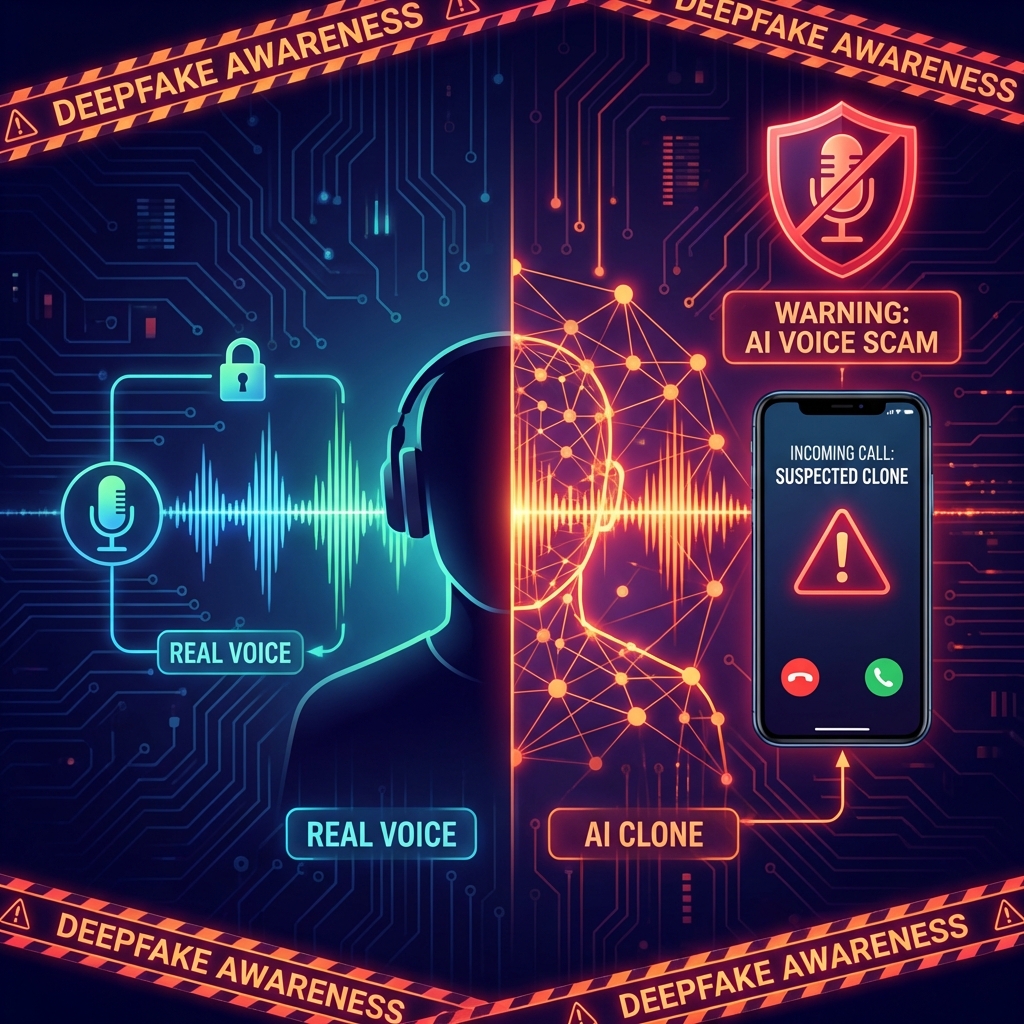
AI voice cloning scams in 2026 do not look like the old robocalls people learned to ignore. The dangerous versions sound personal. A caller uses the voice of your child, spouse, boss, or coworker, creates a believable emergency, and pushes you to act before you think.
That is why these scams work. They bypass the part of the brain that usually says, "This sounds wrong." The voice sounds right, so the victim trusts the story.
The good news is that voice cloning scams are still beatable. The defense is not "listen harder." The defense is process: verify the story on a separate channel, use pre-arranged challenge questions, and refuse to move money or share codes based on a voice call alone.
This guide explains how AI voice cloning scams in 2026 work, who is at risk, what red flags matter most, and what families and businesses should do before a scam call happens.
Why AI Voice Cloning Scams in 2026 Are So Effective
Modern voice cloning no longer requires a studio recording or an advanced lab. Widely available tools can mimic a person's tone, pacing, and speech patterns from a short sample. A criminal does not need a perfect clone. They only need a voice that sounds believable for thirty seconds while the victim is stressed.
That makes voice cloning especially effective in situations where:
- the target expects an emotional call
- the caller creates urgency
- the victim has limited time to verify
- caller ID or a familiar name makes the call feel legitimate
Official guidance from both the FTC and the FBI points to the same conclusion: do not trust the voice by itself, and do not trust caller ID by itself. A convincing voice and a familiar number can both be faked.
In practice, most attacks follow the same sequence:
- The scammer collects audio and personal details from social media, public videos, voicemail, company pages, or previous calls.
- They build a simple scenario that creates panic, secrecy, or urgency.
- They use a cloned or AI-generated voice to make the story feel real.
- They push for money, gift cards, cryptocurrency, login codes, or a rushed approval.
- They try to keep the victim from calling back, checking with another person, or slowing down.
If you remember only one rule, make it this: urgency plus isolation is the real signature of the scam.
How Scammers Get the Audio They Need
Most victims imagine hackers stealing audio from some hidden source. In reality, a lot of voice data is already public or easy to collect.
Common sources include:
- TikTok, Instagram Reels, and YouTube videos
- podcast appearances and webinar recordings
- voicemail greetings
- voice notes shared in public or semi-public groups
- Zoom recordings posted online
- customer service or scam calls that record the victim speaking
- school, sports, and family videos shared on social media
For executives and public-facing professionals, the problem is even bigger. Earnings calls, interviews, keynote talks, investor videos, and livestreams can provide clean audio with enough variation for a convincing imitation.
For families, the risk often comes from oversharing context. A scammer may hear a teenager's voice in one post, learn a nickname from another, and identify parents or grandparents from tagged photos. The attack feels credible because the criminal combines voice data with personal details.
The Most Common Voice Cloning Scam Playbooks
The technology changes fast. The social engineering pattern does not. Here are the scam types we see most often.
1. Family Emergency or "Grandparent" Scam
This is the classic voice cloning attack. A caller claims to be a son, daughter, or grandchild in trouble. The story may involve:
- a car accident
- an arrest
- a lost phone while traveling
- bail money
- medical bills
- a request to keep the matter secret
The voice only has to sound convincing long enough to trigger panic. Once the victim accepts the premise, a second scammer may join the call as a fake lawyer, police officer, or hospital employee.
2. Virtual Kidnapping or Extortion
This version is more aggressive. The attacker uses a cloned voice or distress audio to create the impression that a loved one has been abducted or physically threatened. The goal is the same: stop the victim from checking the story and push for immediate payment.
Even when no one has actually been kidnapped, the emotional shock can overwhelm otherwise careful people.
3. Executive Impersonation and Wire Fraud
Businesses are prime targets because one believable call can trigger a six-figure mistake. A scammer clones the voice of a founder, CEO, CFO, or regional manager and uses it to request:
- an urgent transfer
- a confidential acquisition payment
- a vendor bank-detail change
- payroll or tax data
- a password reset or MFA code
This is often paired with AI-powered phishing. The employee sees a matching email or text, hears the executive's voice, and assumes the request is real.
4. Help Desk or Account Recovery Fraud
Not every voice cloning scam is about direct payment. Some are designed to take over accounts. The attacker impersonates:
- an employee asking the IT team to reset credentials
- a customer calling support to bypass identity checks
- a bank customer asking for account changes
- a partner or vendor requesting access to a portal
Any process that relies on "recognizing the voice" is exposed.
5. Relationship and Trust-Building Scams
Voice cloning also strengthens longer cons. Romance scammers, investment scammers, and pig butchering operators can use AI-generated voices to make a fake identity feel real. After weeks of text messages, a short voice note or call can remove the victim's last doubts.
That is one reason voice cloning appears alongside schemes like pig butchering scams and broader deepfake identity fraud.
The Red Flags That Matter Most
Many people assume the solution is to detect synthetic audio by ear. Sometimes that works, but it is not the most reliable defense. Behavioral signs are usually stronger than audio artifacts.
Behavioral Red Flags
Treat the call as suspicious if the caller:
- demands immediate payment
- insists you stay on the line
- tells you not to call anyone else
- asks for gift cards, cryptocurrency, wire transfers, or payment apps
- requests passwords, OTP codes, or MFA prompts
- claims normal procedures must be skipped "just this once"
- pressures you with legal threats, embarrassment, or fear
These are the signals that matter most because they reveal the scammer's objective.
Audio and Delivery Red Flags
You may also notice:
- awkward pauses before answers
- unusual pronunciation of names, slang, or inside jokes
- speech that sounds emotionally flat or overly clean
- mismatched background noise
- odd timing, lag, or clipped transitions
The FBI has warned that these imperfections can be subtle. The important point is not to become a deepfake audio expert. The important point is to refuse action until independent verification happens.
A Quick Triage Table
| Signal | What It Usually Means | What To Do |
|---|---|---|
| Caller wants money right now | Panic is being used to override judgment | End the call and verify separately |
| Caller asks for secrecy | They are trying to isolate you | Contact another trusted person immediately |
| Caller wants codes or password resets | The goal may be account takeover | Refuse and alert IT or the provider |
| Caller ID looks familiar | It may be spoofed | Ignore the displayed number and call back using a saved number |
| Voice sounds right but details feel off | The audio may be convincing while the story is fake | Verify facts, not tone |
A Family Verification Protocol That Actually Works
Most households still have no plan for this. That is a mistake, because the best time to build a verification habit is before anyone is scared.
Step 1: Create a Family Challenge Question or Safe Phrase
Pick one detail that is:
- easy for close family to remember
- hard for outsiders to guess
- not posted on social media
It can be a safe phrase, but a challenge question often works better because it forces a live answer.
Examples:
- "What was the nickname of our first dog?"
- "Which restaurant did we go to after the graduation?"
- "What phrase do we use when plans change?"
Avoid answers that could be pulled from public posts, school pages, or family photos.
Step 2: Agree on a Hard Rule
Make the rule explicit:
- no urgent money transfer without verification
- no exceptions because someone sounds upset
- no one gets offended by a verification step
This matters because victims often worry that hanging up will make a real emergency worse. Your family rule should remove that hesitation.
Step 3: Use a Call-Back Process
If the request is real, it will still be real after a 60-second pause. Hang up. Call the person back on:
- a number already saved in your phone
- a family group chat
- another known relative or friend
Do not use the number the caller gives you.
Step 4: Practice the Script
People freeze when they are stressed. A short script helps:
"I'm going to verify this on our usual number. If this is real, I will call right back."
That single sentence breaks the scammer's advantage.
Business Controls That Reduce Real Losses
For organizations, voice cloning is not just a fraud issue. It is a process design issue. If one convincing call can move money or change access, the workflow is already too weak.
Do Not Use Voice Recognition as Approval
No payment, bank-detail update, payroll change, or admin reset should rely on:
- recognizing an executive's voice
- a familiar WhatsApp voice note
- a voicemail that "sounds like the boss"
Voice can be one signal, but never the only signal.
Require Out-of-Band Verification
High-risk requests should require a second channel that the requester did not control in the moment. Examples:
- call the executive back through a known internal number
- confirm in the company's approved chat platform
- require approval in the ERP or finance system
- verify with a second approver
Lock Down the Most Abused Workflows
Prioritize controls for:
- wire transfers
- vendor banking changes
- password resets
- MFA resets
- privileged access requests
- payroll updates
This is where attackers aim because the reward is high and the request can sound routine.
Train the Right Teams, Not Just Everyone
Generic awareness training is not enough. Finance, executive assistants, help desk staff, and customer support teams need scenario-based drills built around voice cloning.
Those teams should know:
- how the scam typically unfolds
- which requests always require escalation
- what language to use when slowing the process down
- how to preserve evidence without continuing the conversation
Reduce Unnecessary Executive Audio Exposure
Organizations should review how much clean executive audio is publicly available. The goal is not to disappear from the internet. The goal is to be intentional.
Consider:
- whether every internal town hall needs a public recording
- whether archived media can be access-limited
- whether voicemail greetings should be more generic
- whether sensitive roles need stronger verification workflows because their voices are public
What To Do During a Suspicious Call
When the call is happening, your goal is not to investigate. Your goal is to break the social engineering loop.
Use this order:
- Stop talking. Do not give more voice data, personal details, or background facts.
- Do not send money, gift cards, cryptocurrency, codes, or screenshots.
- Say you will verify the request through a known contact path.
- Hang up.
- Call the real person or organization back using a trusted number.
- Warn anyone else who may be targeted next.
This aligns with FTC and FBI consumer guidance: verify independently, never trust the incoming channel, and do not move money because of pressure.
What To Do If You Already Sent Money or Shared Access
Speed matters. The first hour is far more important than the tenth.
If Money Was Sent
- contact your bank or payment provider immediately
- ask for a wire recall or fraud freeze
- document the exact time, amount, recipient details, and payment method
- preserve voicemails, call logs, texts, and screenshots
If Codes, Passwords, or Access Were Shared
- change passwords right away
- reset MFA where possible
- sign out of active sessions
- notify your employer or IT team if work accounts were involved
- review recent logins and recovery settings
If It Affected a Business Workflow
- notify finance, security, legal, and leadership immediately
- freeze related approvals or payment changes
- check whether the attacker pivoted into email, chat, or vendor impersonation
- preserve evidence for incident response and reporting
Reporting Channels
Depending on location and context, useful reporting paths include:
- ReportFraud.ftc.gov
- IC3.gov
- local police or national fraud reporting channels
- your bank's fraud department
If you need a broader post-incident plan, our small business incident response checklist covers the operational side in more detail.
Can You Reduce the Risk of Your Voice Being Cloned?
You probably cannot eliminate the risk completely, especially if your voice is already online. But you can make abuse harder and reduce the amount of context scammers can pair with your audio.
Practical steps:
- tighten privacy settings on social media
- think twice before posting clear, lengthy voice clips of children or elderly relatives
- use a generic voicemail greeting
- avoid sharing travel details and family relationships publicly in real time
- teach relatives that urgent money requests always require verification
- treat unknown callers as data collectors, not harmless interruptions
For businesses, the equivalent step is to reduce dependency on voice trust instead of trying to hide every audio sample.
Why Thin Advice Fails on This Topic
A lot of content on voice cloning scams stops at "watch out for weird audio." That advice is too thin for the real problem.
Victims do not lose money because they missed a robotic undertone. They lose money because the attacker:
- made the situation feel urgent
- sounded like someone they trusted
- gave them a payment path that felt time-sensitive
- prevented a second opinion
Useful guidance must therefore include both:
- detection guidance: what looks and sounds suspicious
- decision guidance: what process to follow before you act
That is the difference between awareness content and prevention content.
Official Resources Worth Bookmarking
If you want a non-marketing source to share with family or staff, start with:
- FTC consumer alert on AI-enhanced family emergency scams
- FBI alert on AI-generated voice and text impersonation campaigns
- FBI warning on cybercriminal use of AI in phishing and voice/video cloning
These resources reinforce the same practical message: verify through a known channel, slow the process down, and do not send money because a voice sounds familiar.
Received a Suspicious Call?
We investigate social engineering incidents, suspicious voice messages, and payment fraud workflows. If you need help analyzing a voice-cloning scam or tightening your internal verification process, we can help.
Request Voice AnalysisConclusion
AI voice cloning scams in 2026 are dangerous because they attack trust, not just technology. The caller does not need to hack your phone. They need to make you believe a familiar voice and act before you verify.
That is why the strongest defense is procedural:
- never approve urgent requests based on voice alone
- always verify on a separate channel you already trust
- use family challenge questions or business call-back controls
- treat secrecy and urgency as warning signs, not proof
- report fast if money or access was already sent
The technology will keep improving. Your habits can improve faster.
Frequently Asked Questions (FAQs)
1. How much audio do scammers need to clone a voice?
Often not much. A short, clean sample can be enough to create a believable imitation for a brief scam call. Public videos, voicemail greetings, and recorded calls can all provide useful source audio.
2. Can I detect a cloned voice just by listening carefully?
Sometimes, but that should not be your primary defense. High-pressure behavior, secrecy, odd payment requests, and attempts to stop verification are usually more reliable indicators than tiny audio flaws.
3. What should I do if a loved one seems to call in a panic?
Do not send money during the first call. Say you will call back, hang up, and verify the story using a number you already know is real. If you cannot reach them directly, contact another trusted family member or friend.
4. Should businesses allow voice approvals for payments or password resets?
No. Voice alone is not a sufficient authentication factor for high-risk actions. Use call-back verification, dual approval, system-based authorization, and stronger identity checks for resets and financial requests.
5. What payment methods are hardest to recover after a voice cloning scam?
Gift cards, cryptocurrency, and fast wire transfers are usually the hardest to recover because they are designed to move quickly and are difficult to reverse. That is why scammers push those methods so aggressively.
6. If my voice is already online, am I already compromised?
Not necessarily. Public audio increases exposure, but it does not guarantee you will be targeted. The most important step is to make sure your family or company does not rely on voice recognition alone when something urgent or sensitive happens.