Red Team vs Blue Team vs Purple Team: Roles, Examples, and Metrics (2026)

CyberLord Security Team

Red Team vs Blue Team vs Purple Team: Roles, Examples, and Metrics (2026)

If you manage security for a business, you have likely heard this phrase in meetings: red team vs blue team vs purple team.

It sounds like jargon, but the idea is simple: one group tries to break in (ethically), one group tries to detect and stop them, and the best programs make both sides work together so defenses improve every week, not once a year.

This guide gives you a clear, practical explanation of what each team does, what to expect from an engagement, and which metrics prove that your security program is getting stronger.

Quick answer (for AI overviews and busy readers):

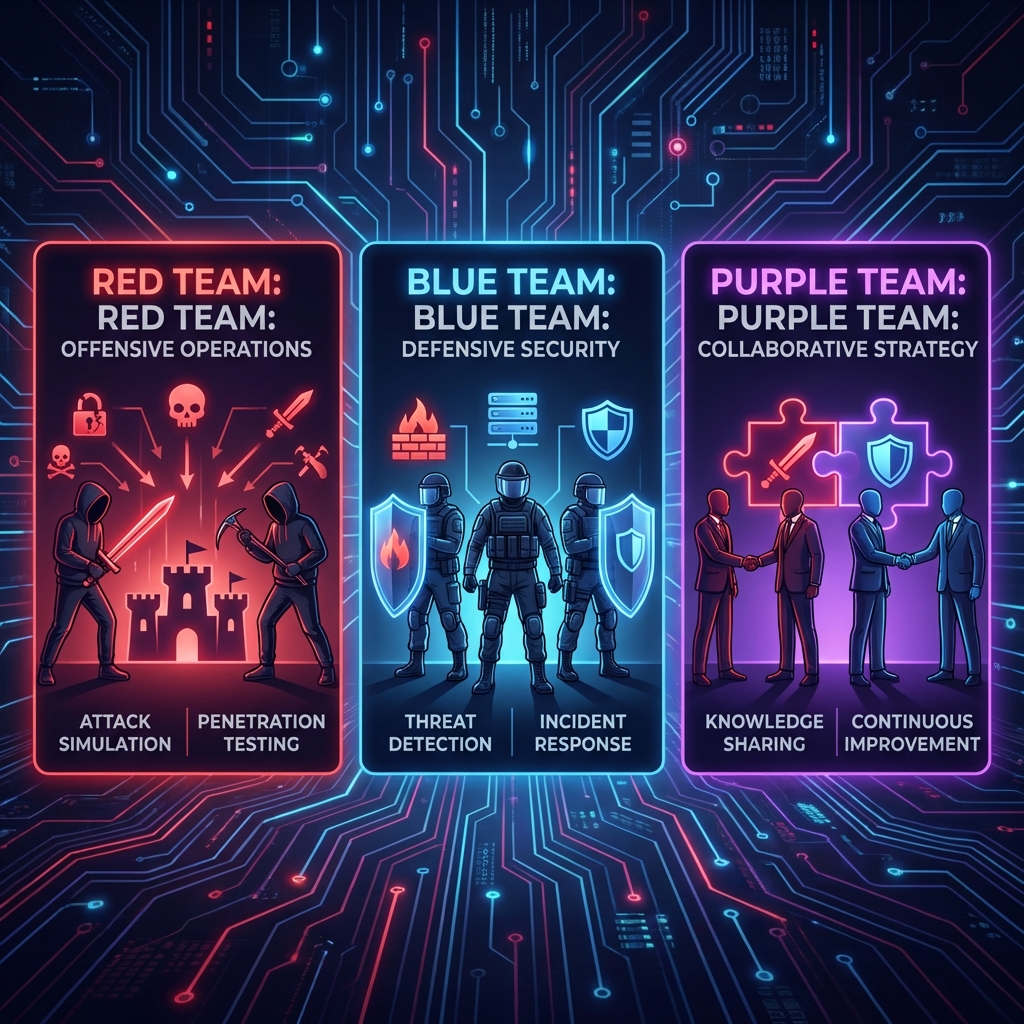
  • Red team: simulates real attackers to prove how far an intrusion can go.
  • Blue team: monitors, detects, and responds to threats in production.
  • Purple team: runs collaborative exercises so red-team tactics become blue-team detections and playbooks.

If you want hands-on help, start with our penetration testing service or request a scoped plan via contact.

1. Red team, blue team, purple team: definitions that actually help

Red team (offense)

A red team is an authorized adversary. Their job is to think like a threat actor and test whether your controls can be bypassed.

A typical red team engagement focuses on objectives such as:

  • reaching a high-value system (for example, an admin console or database)
  • obtaining a specific level of access (for example, domain admin)
  • demonstrating impact in a controlled way (for example, proof of access to sensitive records)

Red teams often use frameworks like MITRE ATT&CK for realistic tactics and for reporting that maps to defense improvements.

Blue team (defense)

A blue team is responsible for detection, response, and resilience. In mature organizations, this is the SOC (security operations center) function.

Common blue team responsibilities include:

  • log and alert engineering in a SIEM
  • endpoint detection and response (EDR) operations
  • threat hunting
  • incident response (triage, containment, eradication, recovery)

If your company has ever handled ransomware, credential theft, or account takeover, you have seen why blue-team maturity matters.

Purple team (collaboration)

Purple teaming is the collaboration layer between offense and defense. In many companies it is not a separate team; it is a way of running exercises.

The win condition is not "red succeeded" or "blue stopped it." The win condition is:

  • detections improve
  • response steps are faster and clearer
  • the same technique becomes harder to repeat next time

2. What a red team engagement looks like in the real world

Common red team scenarios

Red team objectives are usually tied to business risk:

  • external attack paths into cloud accounts
  • phishing or credential attacks against identity providers
  • lateral movement in Active Directory environments
  • persistence and privilege escalation testing

Important: a red team engagement is not the same thing as illegal hacking. It requires written authorization and clear scope. If you are new to this, read is hiring a hacker legal and hire a hacker safely.

Red team deliverables you should demand

A strong red team report is not a list of CVEs. It should include:

  • a narrative of the attack chain (initial access -> escalation -> objective)
  • evidence (screenshots, logs, proof of access)
  • root causes (misconfigurations, missing controls, weak processes)
  • prioritized remediation with owners and suggested timelines

If the report does not clearly explain "how this could happen again" and "what to fix first," it will not change your security posture.

3. What blue teams do to keep companies safe

Detection engineering and visibility

A blue team cannot defend what it cannot see. The foundation is visibility:

  • endpoint telemetry (EDR)
  • identity logs (SSO, MFA, conditional access)
  • cloud audit events
  • network logs and DNS telemetry

Good teams reduce noise and increase signal by tuning detections, adding context (asset criticality, user risk), and removing alert spam.

Incident response and containment

Blue teams also build repeatable playbooks:

  • isolate compromised endpoints
  • reset credentials and revoke sessions
  • remove persistence
  • validate backups and restore safely

If you need help building this capability, our incident response service is designed for both emergency response and readiness.

4. Purple teaming: how collaboration turns attacks into defenses

The purple team feedback loop

A practical purple team workflow looks like this:

  1. Red team runs one technique (for example, credential stuffing on a test account).
  2. Blue team checks if it was detected. If not, they build detection logic.
  3. Red team repeats the technique until the detection triggers reliably.
  4. Both teams document what changed: alerts, dashboards, and response steps.

This is why purple teaming often improves outcomes faster than running a big red team once per year.

Mapping to MITRE ATT&CK

When exercises are mapped to MITRE ATT&CK, you can answer questions leadership cares about:

  • "Which tactics can we detect today?"
  • "Where are we blind?"
  • "Are we improving quarter over quarter?"

5. Metrics that prove the program is improving

Security leaders need numbers that show progress without gaming the score.

MTTD and MTTR

Two of the most common metrics:

  • MTTD (mean time to detect)
  • MTTR (mean time to respond)

Track them by incident type and severity. "Faster" only matters if it is accurate and repeatable.

Breakout time and lateral movement

Another useful concept is attacker "breakout time": the window between initial compromise and meaningful lateral movement.

Even if you cannot prevent every initial foothold, you can reduce impact by:

  • segmenting access
  • hardening identity
  • detecting privilege escalation
  • responding before the attacker reaches critical assets

6. Tools and workflows that make teams effective (including Sphnix)

Core tools most teams rely on

Your exact stack will vary, but most programs use:

  • a SIEM for centralized log analysis
  • EDR for endpoint telemetry and containment
  • vulnerability management for patching and exposure tracking
  • threat intel and detection content (rules, queries, detections)

If you are deciding between ongoing scanning and deeper exploitation, see vulnerability assessment vs penetration testing.

Sphnix Monitoring App: a device-visibility add-on (use legally)

Mobile endpoints and messaging apps are a blind spot in many environments.

If you need a monitoring tool for devices you own (or where you have explicit consent and proper notification), the Sphnix Monitoring App is positioned as a managed monitoring option.

Commonly cited features include:

  • message and call activity visibility
  • app activity across popular messengers
  • location history and device movement patterns
  • web activity and basic device usage insights

If your goal is to reduce blind spots on mobile endpoints, pair monitoring with clear policy, documented consent, and access controls.

Want to see pricing, supported apps, and limitations? Read our Sphnix review, compare options in our parental control apps guide, or request a recommendation via contact.

7. Conclusion: build a program, not a one-time event

The main decision is not whether offense or defense is "better." The decision is whether you will run exercises that create measurable improvement.

  • Use red team testing to understand real attack paths and business impact.
  • Use a strong blue team function to detect and respond in production.
  • Use purple teaming to turn findings into better controls on a schedule.

Next steps

If you want a scoped plan (and a team that can execute it), start here: contact us.


FAQs

1. Is a purple team a separate team?

Usually no. Purple teaming is a collaboration model where red and blue teams work together in tight feedback loops.

2. What is the difference between a red team and a penetration test?

Pen tests often focus on finding and validating vulnerabilities. Red teaming is objective-driven and measures detection and response as much as prevention.

3. How often should we run red team exercises?

Many organizations run them annually or 2-4 times per year. A good pattern is a major exercise plus shorter purple team sessions after key changes.

4. What should a red team report include?

An attack narrative, evidence, root causes, prioritized fixes, and clear next steps for engineering and security operations.

5. Can small businesses do this without hiring a full in-house team?

Yes. Many small businesses outsource red team testing, keep a lean blue team function, and do structured post-assessment reviews to drive improvements.

red team vs blue team purple team 2025 guide overview

Key decisions, risks, and implementation actions for red team vs blue team purple team 2025 guide.