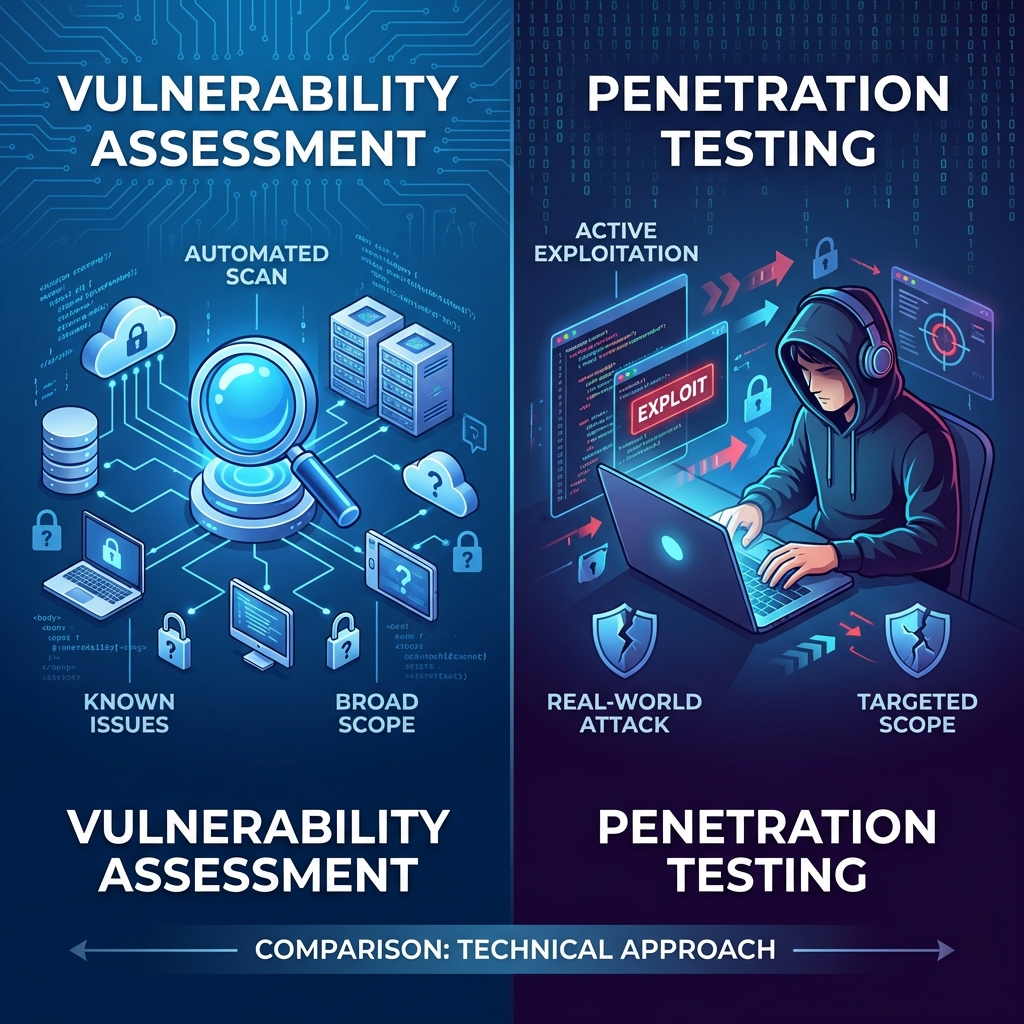
Vulnerability Assessment vs Penetration Testing: Differences and Decision Guide (2026)
Cyberlord Secure Services

If you have ever paid for a "security assessment" and ended up with a spreadsheet of findings you cannot prioritize, you already understand the problem.
The confusion around vulnerability assessment vs penetration testing is one of the most expensive mistakes businesses make in security. One approach gives you breadth and repeatability. The other proves what an attacker can actually do.
This guide shows you exactly what each one is, what you receive at the end, and how to choose the right option based on risk, compliance, and budget.
Quick answer:
- Run a vulnerability assessment to find and track exposures across all assets.
- Run a penetration test to validate exploitability and measure real impact.
- Combine both into a program that includes remediation and retesting.
If you want help scoping either one, see vulnerability assessment services and penetration testing.
1. Definitions: what each service actually is
Vulnerability assessment
A vulnerability assessment is a structured process to identify and prioritize known weaknesses across your environment. The emphasis is coverage:
- missing patches (CVEs)
- weak configurations
- exposed services and risky defaults
- insecure versions of software and libraries
A good assessment also reduces noise by validating findings, grouping root causes, and producing an actionable remediation plan.
Penetration testing
Penetration testing is a simulated attack performed with written permission. The emphasis is proof:
- can a weakness be exploited?
- what is the blast radius?
- what is the business impact?
Pen tests often include manual testing and deeper logic checks (authentication, authorization, and application workflows) that scanners miss.
2. The biggest differences (table + plain-English explanation)
Breadth vs depth
A vulnerability assessment is designed for coverage across many assets. Penetration testing is designed for depth against the paths that matter most.
List vs proof
Assessments help you prioritize what to fix. Pen tests help you prove what is exploitable and what the impact looks like if an attacker chains weaknesses together.
Here is the shortest comparison that still stays accurate:
| Area | Vulnerability Assessment | Penetration Testing |
|---|---|---|
| Goal | Find and prioritize weaknesses | Prove exploitability and impact |
| Method | Broad scanning + validation | Manual testing + controlled exploitation |
| Output | Risk-ranked exposure list | Attack narrative + evidence + fixes |
| Coverage | Wide (many assets) | Deep (critical assets and paths) |
| Best for | Continuous hygiene | Go-live validation and assurance |
Plain-English analogy:
- A vulnerability assessment is an inspection that lists weak doors and windows.
- A penetration test is hiring a professional (authorized) to show which doors actually open and what they can access once inside.
3. What you should receive at the end (deliverables)
Vulnerability assessment deliverables
Do not accept "raw scanner output" as the final product.
A strong assessment deliverable includes:
- validated findings (reduced false positives)
- asset context (what is internet-facing, what is critical)
- CVSS plus business risk notes
- patch and configuration guidance
- a remediation backlog your IT team can execute
If you want a fast way to separate credible vendors from low-quality ones, ask for a redacted sample report.
Penetration test deliverables
A penetration test should include:
- executive summary with business risk
- technical detail with reproducible evidence
- screenshots and proof-of-access where appropriate
- attack chains (how small issues combine into major impact)
- prioritized remediation and retest options
Pen testing is also where many teams discover identity and access issues, such as overly-permissive roles and weak MFA policies.
4. Cost, time, and operational impact
Typical cost ranges
Prices vary widely by scope, but as a rough reference:
- vulnerability assessments are generally lower-cost and repeatable
- penetration tests cost more because they require expert time and careful manual work
If you are trying to decide between spending more on testing or fixing what you already know is broken, consider a staged approach: assess, remediate the top risks, then validate with a pen test.
Impact and safety
Assessments are usually low-risk because they are non-intrusive.
Pen tests can be more disruptive if they include aggressive testing. That is why scoping and rules of engagement matter:
- test windows
- rate limits
- explicit exclusions
- escalation contacts
If you are new to this, read is hiring a hacker legal so the paperwork and authorization are handled correctly.
5. Compliance and audit expectations
Compliance is not the reason to do security testing, but it often sets a minimum standard.
PCI DSS
PCI environments commonly require routine vulnerability scanning and periodic penetration testing (and retesting after major changes).
SOC 2
Most SOC 2 audits expect evidence of a vulnerability management program and regular testing. A penetration test report is often the simplest artifact auditors understand.
ISO 27001
ISO programs are built around risk management and continuous improvement. Assessments help show ongoing hygiene, while pen tests demonstrate independent validation.
HIPAA and GDPR
Healthcare and privacy-driven environments often use both: assessments for continuous controls and pen tests to validate access boundaries around sensitive data.
6. Building a testing program that actually reduces risk (including Sphnix)
A common failure mode is paying for testing and never closing the loop.
A simple quarterly pattern
Here is a model that works for many businesses:
- monthly or continuous vulnerability assessment cadence
- remediation sprint focused on critical and high-risk items
- penetration test after major releases or at least annually
- retest to confirm fixes
If you want a program that also measures detection and response (not just exposures), add a red team layer. See red team vs blue team vs purple team.
Sphnix Monitoring App: where it can fit (lawful use only)
Testing tells you what is wrong. Monitoring helps you see what is happening after changes are made.
If you need visibility into company-owned mobile devices (or parental monitoring for minors, with appropriate consent and local legal compliance), the Sphnix Monitoring App is marketed as a managed monitoring option.
Frequently mentioned features include:
- call and messaging activity visibility
- app activity across common messengers
- location history and movement patterns
- web activity and device usage insights
For a deeper feature breakdown and legal guidance, read our Sphnix review.
Want a recommendation based on your situation? Reach us via contact.
7. Conclusion: choose based on risk, then validate
If you only remember one line, make it this: vulnerability assessments help you manage exposure at scale, while penetration tests prove impact.
Most teams do best when they treat vulnerability assessment vs penetration testing as a sequence, not a debate:
- find and prioritize
- fix the top risks
- validate exploitability
- retest and repeat
Next steps
If you want a scoped assessment with clear deliverables, request a proposal here: contact.
FAQs
1. Is a vulnerability scan the same as a vulnerability assessment?
No. Scanning is an automated step. An assessment includes validation, prioritization, and a remediation plan.
2. How long does a penetration test take?
For many small to mid-size scopes, 1-2 weeks is common. Complex environments or multiple apps can take longer.
3. Which one should we do first?
If you have never done either, start with a vulnerability assessment to establish baseline hygiene, then run a penetration test to validate critical paths.
4. Can we do a vulnerability assessment in-house?
Often yes, if you have the tools and expertise. Many teams scan internally and use an external partner for penetration testing to get deeper expertise and independent validation.
5. What should we ask for before signing with a testing vendor?
Ask for written scope, authorization language, a redacted sample report, retest options, and clear expectations on what evidence you will receive.
vulnerability assessment vs penetration testing 2025 guide overview
Key decisions, risks, and implementation actions for vulnerability assessment vs penetration testing 2025 guide.